Does Skipping Maintenance Void a Tankless Water Heater Warranty?
Manufacturer scale-damage exclusions, certified-technician and documentation requirements, registration, and why service records matter.
From what I have seen in the field, a denied warranty claim is one of the most frustrating surprises a homeowner can face. Most people assume their new system is fully covered for a decade or more. The reality is that understanding your tankless water heater warranty maintenance requirements is crucial. Skipping regular tankless water heater maintenance does not automatically cancel your entire policy, but it can absolutely cost you coverage when you need it most.
We see this exact scenario play out weekly here in Southern California.
Let’s look at the data, what it actually means for your coverage, and how you can protect your investment. I am going to break down the specific manufacturer exclusions and walk through the exact steps to keep your coverage rock solid.
The Short Answer
Does skipping maintenance cause a tankless warranty void? It will not automatically cancel the entire policy, but it often voids coverage for the heat exchanger if the failure is caused by scale buildup. Many major manufacturers specifically exclude tankless warranty scale damage from their standard protections.
Our team handles dozens of warranty claims every month.
Southern California tap water is notoriously hard, consistently measuring between 11 and 17 grains per gallon (GPG) in 2026. This high mineral content makes scale the single most common cause of serious tankless failures in our region. If your heat exchanger fails due to these hard water deposits, an unmaintained unit will likely be denied coverage. Replacing a heat exchanger out of pocket easily costs between $1,000 and $1,500 for parts and labor in 2026.
Regular maintenance with dated records is the absolute simplest way to protect yourself from that expense. Here is how these warranty terms typically function in the real world.
Manufacturer Scale-Damage Exclusions
Tankless warranties commonly separate coverage into distinct parts like the heat exchanger, other components, and labor. Each of these categories carries its own time period and specific exclusions.
Our service department reads these policies daily, and damage from local hard water is almost universally excluded.
Brands like Rinnai and Navien explicitly state in their 2026 manuals that warranties do not cover damage if the water hardness exceeds 11 or 12 GPG. Since most Southern California municipalities supply water well above that limit, you are immediately at risk without proper maintenance or water treatment.
Common exclusions you will find in your documentation include damage from:
- Scale, lime, or heavy mineral buildup
- Water quality falling outside the manufacturer limits
- Freezing temperatures or improper winterization
- Improper installation, venting, or gas supply issues
- A lack of required annual maintenance
Exact wording varies by brand and model, so read your specific warranty document carefully. Manufacturers usually post their most up-to-date warranty terms online by model number if you have lost the physical copy.
Why scale matters so much
The heat exchanger is the most expensive part of a tankless unit, and it often carries the longest warranty. It is also the exact component that scale destroys first. An exclusion for scale means the most valuable part of your coverage simply does not apply.
Certified-Technician and Documentation Requirements
Some warranties strictly require that all installation and service be performed by a licensed or qualified professional to remain valid. DIY repairs or unverified handyman work can instantly void your labor coverage.
We strongly recommend using certified professionals because it puts you in a much stronger position if a claim is ever questioned.
Many manufacturers operate specific certified installer programs that provide added benefits for the homeowner. For example, hiring a Navien Service Specialist (NSS) often ensures faster processing because these technicians have a direct line for Return Goods Authorization (RGA). This specialized access means replacement parts are often approved and shipped overnight.
Our technicians are factory-certified by leading manufacturers to guarantee your system is serviced to their exact specifications.
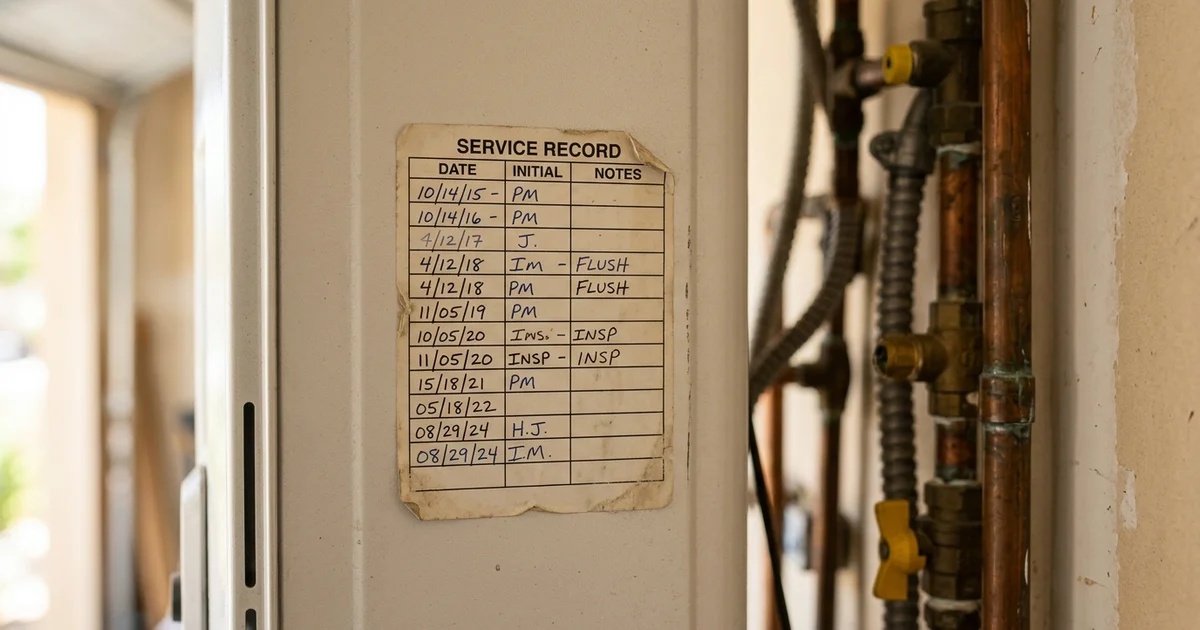
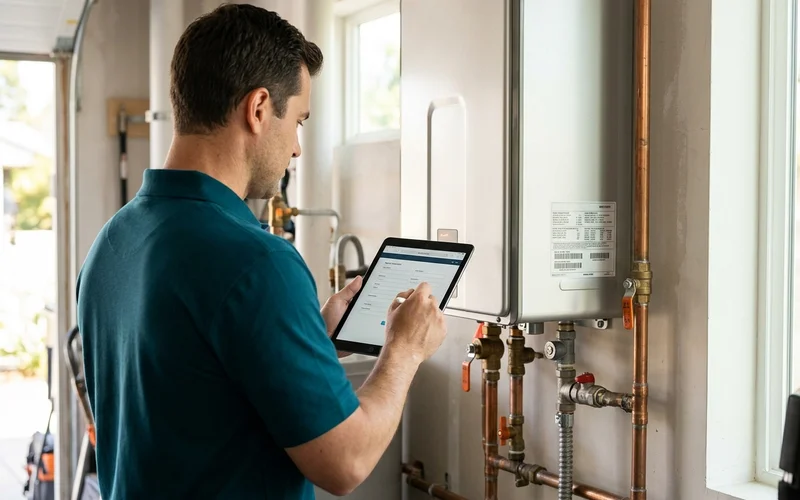
Every service visit ends with a detailed written report and a dated record for your files. Having this paperwork readily available eliminates any guesswork if a component fails prematurely.
Warranty Registration
Many manufacturers require or strongly encourage product registration within a set 30 to 90-day period immediately after installation. Failing to register your unit in this tight window can drastically reduce your coverage. For instance, a standard 15-year heat exchanger warranty might drop to just 5 years if the paperwork is ignored.
Registration creates an official record of the install date and often qualifies you for the full, extended coverage tier.
We register the tankless warranty registration on every single installation we perform to ensure our customers get the maximum protection available.
If you are unsure if your unit was ever registered, check the manufacturer website using your serial number. Late registration is sometimes possible, though the extended terms may no longer apply.
Keeping Service Records
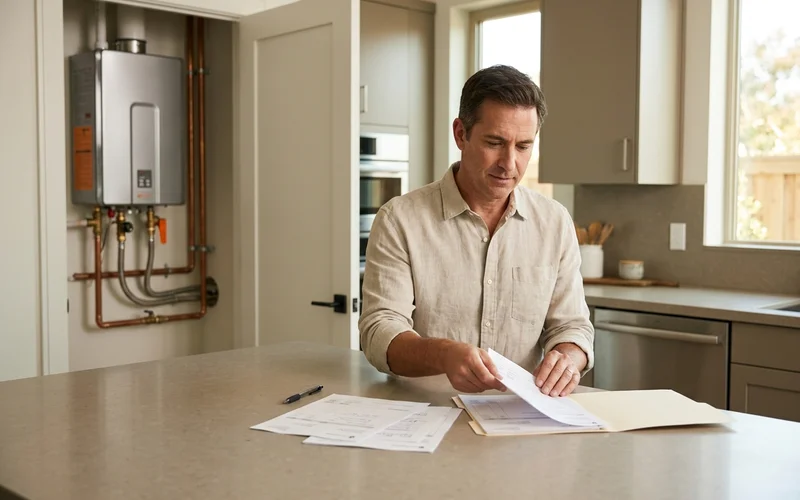
If you ever need to file a claim, the manufacturer will likely ask for hard proof that the unit was properly installed and maintained. Keeping your documents organized is the best defense against a denied claim. A simple folder or a dedicated digital photo album of each invoice saved in one place is completely sufficient.
You should gather and maintain these specific documents:
| Record | Why it matters |
|---|---|
| Installation invoice | Shows the install date, the contractor license, and who installed it |
| Warranty registration confirmation | Proves the unit was registered within the required window |
| Permit and inspection record | Supports that the installation met all local building codes |
| Dated maintenance invoices | Shows proper flushing and descaling service was done on schedule |
| Service reports | Documents specific findings like scale levels, gas pressure, and incoming water pressure (ideal is 50-80 PSI) |
Our team provides a comprehensive service report after every visit specifically to help you build this file.
This documentation is invaluable because it proves the unit was operating within acceptable parameters before the failure. Manufacturers rarely argue with a stack of professional, data-backed invoices.
If You Need to File a Claim
When a covered part fails, a smooth and successful claim process usually comes down to your upfront preparation. Knowing exactly what to provide the manufacturer speeds up the approval timeline significantly.
Our office handles these calls frequently, and organization is always the key factor.
If your unit flashes an error code, such as an “LC” or “00” code on a Rinnai indicating scale buildup, write it down immediately. Follow these specific steps to streamline your claim:
- Find your records before you call the manufacturer. Have your installation invoice, registration confirmation, and all maintenance invoices ready.
- Have the exact model and serial number ready. These are clearly printed on the rating label on the side of the unit.
- Let a qualified technician diagnose the failure. Manufacturers typically require a professional to determine which part failed and the root cause.
- Ask exactly what is covered. Parts and labor are often treated differently. Some labor warranties expire after the first year.
- Keep the failed part. The manufacturer may require the defective component to be returned before they release the credit.
If a manufacturer questions a claim because of suspected neglect, dated service records showing regular descaling are your absolute strongest evidence. That is the exact practical reason a professional technician leaves a clear written record after every single maintenance visit.
How Often Should You Service for Warranty Purposes?
Check your specific owner manual for the baseline recommendation from the manufacturer. Annually is the most common and widely accepted baseline requirement in Southern California. However, extremely hard water or a very busy household may require service every six to nine months to prevent scale from hardening.
A proper warranty-compliant service requires circulating food-grade white vinegar or a dedicated descaling solution through the unit for at least 45 minutes at a rate of 2.5 to 3 gallons per minute.
The comprehensive guide comparing a basic flush with full maintenance explains exactly which service to choose based on your water quality. You can also read what happens during tankless maintenance to walk through every step of a professional visit.
We strongly encourage homeowners to stay ahead of the schedule rather than waiting for a drop in water pressure.
If your unit is currently overdue, book a full-service visit right away. You will get a completely clean heat exchanger, a tuned gas burner, and a fresh dated record to add to your warranty file.
We want your system to provide endless hot water for years without issue.
If you are ready to get your equipment back on track, contact a certified professional to schedule your next descaling service. Taking action now ensures your warranty remains valid when you need it most.