What Happens During a Full Tankless Maintenance Service
Visit length and hot-water downtime, valve isolation and flush, combustion-side cleaning, gas calibration and your post-service report.
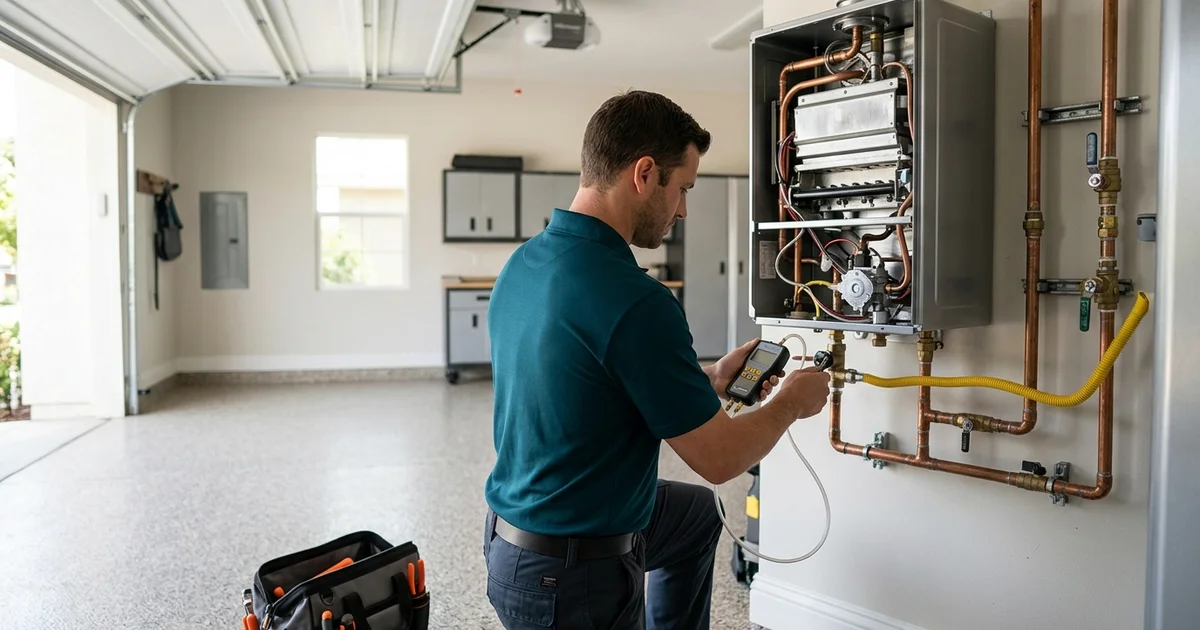
We know the exact frustration of jumping into a lukewarm shower right when you need to get moving.
Waiting for reliable hot water makes a busy morning feel impossible.
Our tankless water heater maintenance service takes the guesswork out of keeping your system running perfectly.
This comprehensive, $479 full-service visit is exactly what Southern California homeowners need to protect their eco-friendly investment.
We want to show you exactly what is included in tankless water heater service during a standard call.
Let us walk through the process from the moment a technician arrives until you receive your final report.
What to Expect, Step by Step
We designed this guide so you know exactly what the job involves before picking up the phone.
Reviewing a tankless maintenance checklist is much easier when you understand the physical process.
Our technicians follow a strict, tested protocol from arrival to the final diagnostic report.
You will see exactly where your $479 investment goes during this thorough system checkup.
Before the Visit
We schedule these comprehensive maintenance visits Monday through Friday between 9 AM and 5 PM.
Providing a few specific details before your tankless service visit helps the process go smoothly.
Our team strongly recommends telling us your unit’s brand and model, or just sending a quick photo of the rating label.
This simple step ensures the technician arrives with the correct OEM parts for your specific Rinnai, Navien, or Noritz system.
We also need to know a few more details to prepare properly:
- When the unit was last serviced
- Any error codes flashing on the display
- Strange noises or temperature drops you have noticed recently
Clearing about three feet of space around the unit allows safe physical access.
Our technicians also need a clear path to reach the shutoff valves underneath the heater.
Visit Length and Hot-Water Downtime
We typically spend about two hours completing a full diagnostic visit.
A standard diagnostic check on modern, high-efficiency Title 24 units requires careful attention to detail.
Our process requires shutting off the hot water only while the actual mechanical work happens.
Cold water continues flowing normally to every other fixture in the house.
We suggest running the dishwasher or taking showers before the appointment officially begins.
Planning around this short window means you will barely notice the temporary pause in service.
Our main priority is getting your eco-friendly, endless hot water flowing again rapidly.
Step 1: Inspection and Code History
We begin the visit by examining the entire physical installation setup.
The technician inspects the exterior vent, gas connection, main water lines, and the condensate drain on high-efficiency models.
Our initial visual sweep looks closely for any early signs of dangerous leaks or hidden corrosion.
Catching a small drip early prevents massive drywall damage down the line.
We then pull the stored error code history directly from the digital control board.
These saved codes reveal temporary problems that might not be happening during the actual appointment.
Our experts know that an intermittent Code 11 on a Rinnai unit indicates a previous ignition failure.
This hidden diagnostic data tells the exact story of how your unit performed over the last twelve months.
Step 2: Service Valve Isolation and Flush
We start the physical cleaning by turning off the gas and electrical power to your unit.
Closing the isolation service valves on the water lines ensures no chemical cleaning solution enters your home plumbing.
Our technician then connects a specialized utility pump and heavy-duty rubber hoses to the exterior service ports.
Southern California water is notoriously hard, often testing between 11 and 17 grains per gallon (GPG) in areas pulling from the Colorado River.
We circulate a professional-grade descaling solution, like Hercules Haymaker, directly through the copper heat exchanger.
This citric acid-based liquid dissolves stubborn calcium carbonate scale three times faster than plain white vinegar.
Our team flushes the entire system with fresh municipal water after the chemical circulation cycle finishes.
This final rinse clears out all remaining acidic solution and loosened mineral debris.
We can easily install new isolation valves today if your current setup lacks them.
Having proper brass valves makes every future maintenance flush significantly faster and more affordable.
Step 3: Inlet Filter Screen Cleaning
We carefully extract and clean the inlet water filter screen located right at the cold water connection.
This tiny mesh barrier traps incoming street debris before it can damage delicate internal flow sensors.
Our experience shows that a clogged screen quietly throttles your maximum hot water flow rate.
Even a small pebble can drop your output from a luxurious seven gallons per minute down to a frustrating trickle.
Step 4: Combustion-Side Cleaning
We remove the front cover to access and directly service the burner components.
A clean combustion chamber is critical for maximizing energy efficiency and keeping your monthly utility bills low.
Our team focuses on two major parts during this crucial phase:
- Combustion fan. The technician wipes down the fan blades and clears the surrounding housing. Dust or lint caught here blocks crucial airflow and frequently triggers venting error codes.
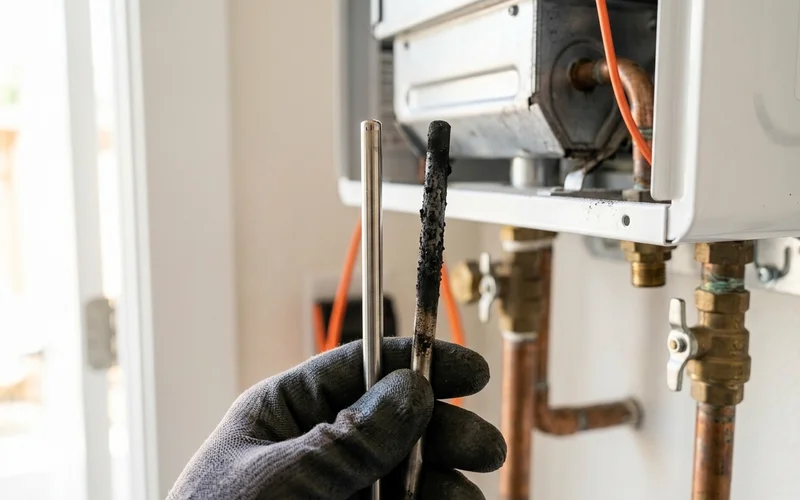
- Flame rod. The technician gently cleans the sensitive electronic flame sensor. A carbon-coated rod sends a weak electrical signal, usually dropping below the required 1.0 microamp threshold, which causes immediate safety shutdowns.
Step 5: Gas Pressure Calibration
We turn the gas and power back on to prepare for active system testing.
The technician connects a highly sensitive digital manometer directly to the internal gas test port.
Our baseline test measures the standing gas pressure while the unit is completely resting.
SoCalGas typically delivers residential gas at a standard 7 to 8 inches of water column pressure.
We then fire the unit up to maximum capacity and measure the dynamic pressure drop.
Most high-efficiency systems require a sustained dynamic pressure of at least 4 to 5 inches of water column to operate correctly.
Our technician executes a precise tankless gas pressure adjustment to match the original manufacturer specifications.
Perfect calibration guarantees clean combustion, maximum heat output, and a massive reduction in future ignition failures.
We will explain exactly what is happening if your supply pressure drops too low during this full-fire test.
A severe drop often points to an undersized gas meter or a restricted underground supply line.
Why calibration matters
Gas pressure that’s too low causes ignition and flame-loss codes. Pressure that’s off-spec in either direction affects efficiency and combustion quality. A flush alone never checks this.
Step 6: Full-Cycle Test
We turn on the hot water at a distant sink or shower fixture to force a heavy demand cycle.
The technician closely watches the unit run through a complete sequence of ignition, full modulation, and safe shutdown.
Our final visual inspection confirms the exact output temperature and verifies the total water flow rate.
Watching a complete cycle ensures no hidden error codes trigger under a real physical load.
We perform one last physical check on every single pipe connection touched during the visit.
Confirming everything is perfectly water-tight gives you total peace of mind for the year ahead.
Step 7: Your Post-Service Report
We provide a detailed written summary before leaving your driveway.
This document outlines everything completed during the two-hour maintenance appointment.
Our goal is total transparency regarding the current health of your plumbing system.
Here is a complete breakdown of what the summary includes:
| Report item | What it tells you |
|---|---|
| Work performed | Flush, screen, fan, flame rod and gas calibration completed |
| Scale observations | How much buildup we found, which guides your next interval |
| Gas pressure readings | At rest and at full fire, against factory spec |
| Issues found | Worn parts or concerns, with a written quote if a repair is needed |
| Next-service date | Our recommendation based on your water and usage |
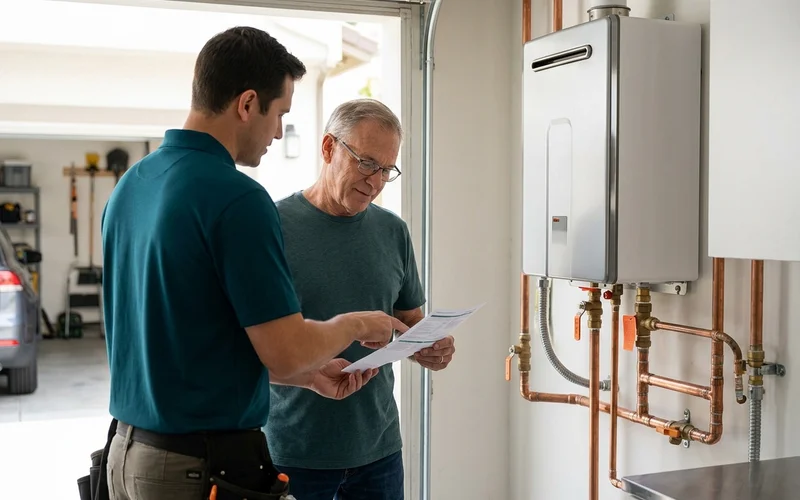
We highly recommend keeping this specific report filed securely with your original installation paperwork.
Dated service records are absolutely required by manufacturers to approve any future warranty claims.
Our comprehensive guide covering does skipping maintenance void your warranty explains these strict factory requirements in greater detail.
Questions Worth Asking Your Technician
We love when homeowners want to understand how their plumbing actually works.
This maintenance visit is the perfect opportunity to learn the mechanical quirks of your specific machine.
Our trained technicians are always happy to answer questions like these before wrapping up the visit:
- How much scale did you find? Pulling heavy calcium chunks out of the system means you likely need a shorter maintenance interval next time.
- Were the gas pressure readings in spec before you adjusted them? A massive drift away from original factory settings points to a degrading local supply line.
- Is my unit sized correctly for my household? Mentioning any recent capacity struggles helps us verify if your current system can actually handle the demand.
- Is the neutralizer still good? Condensing units produce highly acidic runoff, and the protective neutralizing media usually needs replacement every 12 to 24 months.
- Are my isolation valves working smoothly? Stiff or leaking brass valves make future emergency water shutoffs incredibly difficult.
- Anything I should watch for between visits? Specific humming noises, blinking codes, or sudden flow changes mean you should call us before the next scheduled visit.
How Often to Book Full Service
We know there is no universal maintenance schedule that fits every single house perfectly.
Many standard households safely book a full service every other year, alternating with a simpler basic flush.
Our technicians strongly suggest annual full service for homes dealing with extremely hard water or heavy daily usage.
Southern California commercial units almost always require accelerated maintenance schedules to survive the brutal mineral content.
| Household | Typical approach |
|---|---|
| Light use, moderate water | Alternate full service and flush |
| Busy household, hard water | Full service annually, flush as recommended |
| Recurring ignition or flame-loss codes | Full service now, then follow the report |
| Commercial or multi-unit | Scheduled service based on run hours |
We take the guesswork entirely out of the equation with your personalized post-service report.
The recommended date printed on that final invoice is the exact timeline you should follow.
If We Find a Problem
We will immediately bring any unexpected issues to your attention before proceeding with repairs.
Discovering a failing igniter or a weeping pressure relief valve requires a quick conversation.
Our standard protocol requires giving you a clear, written quote for any necessary replacement parts.
Nothing extra happens to your system without your explicit, written approval first.
We guarantee there are zero hidden administration fees or surprise diagnostic charges added to the bill.
Honest pricing builds long-term relationships with homeowners in our local community.
Flush or Full Service?
We might suggest scaling back if your unit runs perfectly and recently had a comprehensive checkup.
A fast, basic flush costs roughly $200 to $250 and might be all your system requires right now.
Our detailed flush vs full maintenance guide outlines exactly how to alternate between the two options safely.
Selecting the right tier of service protects your wallet while keeping the hot water flowing beautifully.
We are ready to help whenever you decide to move forward with booking an appointment.
Simply request a time online or call the office directly to lock in a weekday visit.
Our team is standing by to ensure your home enjoys perfectly heated water all year round.