What Is a Tankless Water Heater and How Does It Work?
See how a tankless water heater heats water on demand, why it avoids standby loss, and what GPM and BTU ratings mean for your home.
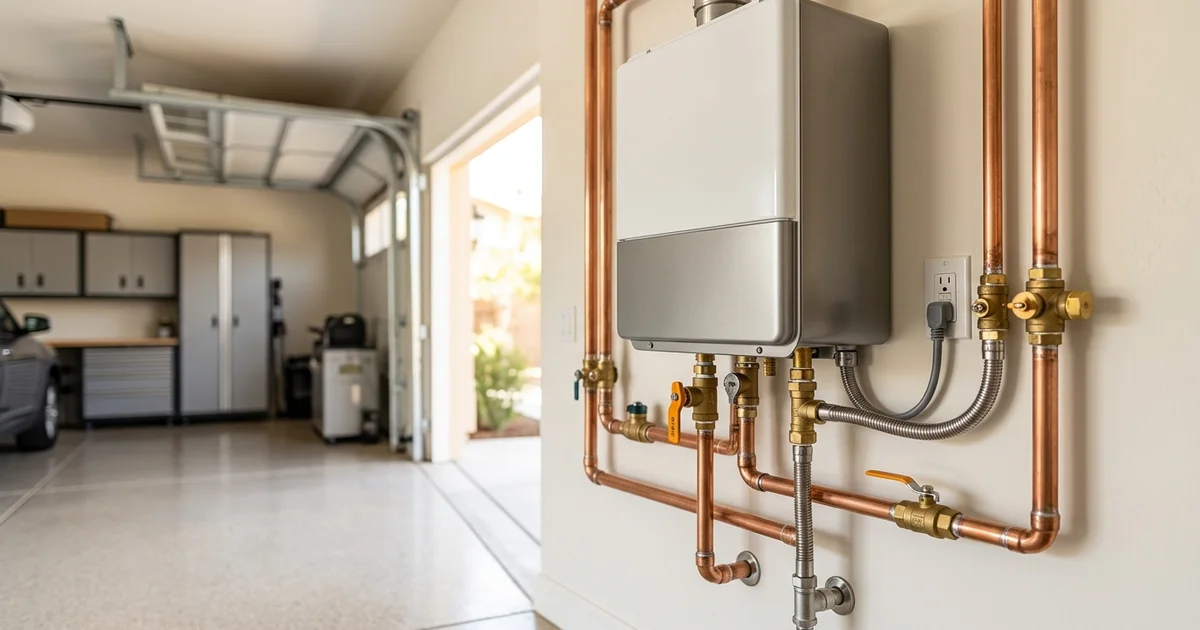
Our team consistently notices that property owners underestimate how much energy a standard storage tank wastes through standby heat loss. You probably know your traditional unit keeps 40 to 50 gallons hot 24/7, but that constant reheating cycle drives up utility bills unnecessarily.
That inefficiency is why shifting to an on-demand water heater makes so much sense for modern homes.
We handle tankless water heater services in Los Angeles and across Orange and Ventura Counties, seeing the financial impact of this switch every single day. A modern unit completely eliminates standby loss because it only burns gas when water is actively flowing.
For homeowners asking, “how does a tankless water heater work?”, let’s look at the mechanics inside these systems and explore the key performance metrics you need to evaluate.
How a Tankless Water Heater Heats Water on Demand
A tankless water heater explained simply comes down to a highly precise sequence of events governed by internal sensors. The exact moment you open a hot water tap, the unit springs into action. There is no storage tank holding heated water in reserve.
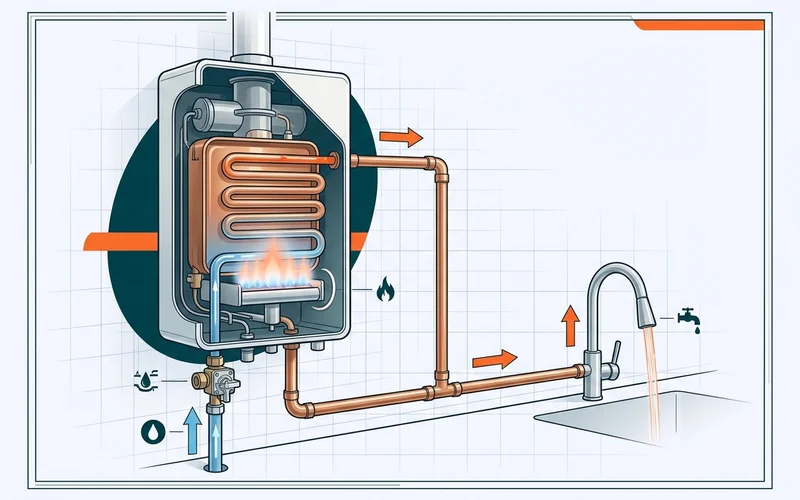
We regularly explain to customers that the secret to how tankless heaters heat water relies on passing cold water through a compact heat exchanger. The water gets heated in seconds and flows straight to your shower or sink. Once you close the tap, the burner shuts down completely.
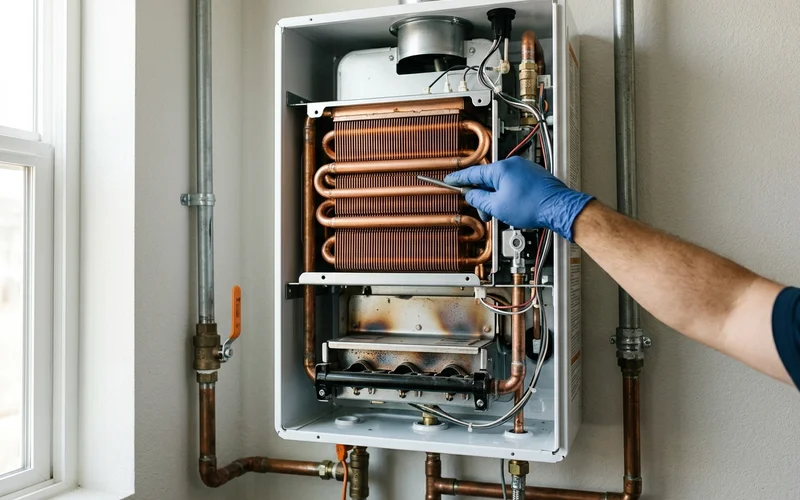
Here is the exact sequence every time you turn on the hot water:
- Flow is detected. A flow sensor, often a tiny turbine, notices water moving through the unit. Most units require a minimum activation flow of around 0.4 to 0.5 gallons per minute before they ignite.
- The fan starts. A combustion fan pushes air through the burner and out the vent.
- The burner lights. An igniter lights the gas, and a flame sensor confirms the flame is present.
- Water is heated. Cold water travels through the heat exchanger, a coil of tubing surrounded by the burner’s heat, and leaves at your set temperature.
- The board adjusts. Temperature sensors at the inlet and outlet tell the control board how hard to fire. It modulates the flame to match your flow.
- Everything shuts off. Close the tap, flow stops, and the burner and fan shut down.
Why no standby loss matters
A tank loses heat through its walls all day and reheats water you aren’t using, whereas a tankless unit only burns gas while water is actively flowing. U.S. Department of Energy data shows this eliminates standby loss, making tankless units up to 34% more energy efficient for homes using under 41 gallons daily. That is where most of the energy savings come from.
One common pitfall involves low-flow fixtures dropping the flow rate below that 0.4 GPM threshold. If you install an ultra-restrictive showerhead, the heater might not detect the demand, causing the burner to shut off and leaving you with cold water.
What GPM and BTU Ratings Mean
Two specific numbers dictate exactly what a tankless unit can handle in your home. These metrics determine whether you can run the dishwasher and take a shower simultaneously without the water running cold.
- GPM (gallons per minute) represents how much hot water the unit can deliver at once. A standard shower requires roughly 2 GPM, a kitchen faucet uses around 1.5, and a dishwasher needs about 1 to 1.5. Add up the demand of everything you plan to run at the same time to calculate your peak simultaneous flow.
- BTU (British thermal units) measures the heating power of the burner. Whole-home gas tankless units from brands like Navien and Rinnai commonly range up to 199,000 BTU. Compare that with roughly 40,000 BTU for a standard gas storage tank. Higher BTU capacity allows the unit to heat a larger volume of water per minute.
Our installation crews frequently see homeowners make a critical mistake when reading GPM ratings on spec sheets. The manufacturer’s maximum GPM rating depends entirely on the required temperature rise, which is the difference between the incoming cold water and your target output temperature.
Here in Southern California, municipal groundwater temperatures hover in the mid-70s during summer but can plummet to around 52°F in winter. A unit attempting to reach a standard 120°F tap temperature needs a 45°F rise in July, but requires a massive 68°F rise in January. This hidden thermal demand means a heater promising 8.6 GPM in summer might only deliver 5.5 GPM during the winter months.
| Rating | What it measures | Why it matters to you |
|---|---|---|
| GPM | Hot water flow at a given temperature rise | Decides how many fixtures can run at once |
| BTU input | Burner heating power | Decides capacity and the gas line size you need |
| UEF | Uniform Energy Factor (efficiency) | Higher means lower operating cost |
| Minimum activation flow | Flow needed to fire the burner | Affects very low-flow faucets |
Condensing vs Non-Condensing in Brief
Every modern gas tankless heater falls into one of two design categories. The choice you make impacts both your upfront installation costs and your long-term utility savings.
- Non-condensing units utilize a single primary heat exchanger and vent hot exhaust directly outdoors through a specialized stainless steel pipe. This traditional design is reliable and generally features a lower initial purchase price.
- Condensing units achieve much higher efficiency ratings by adding a secondary heat exchanger to capture extra thermal energy from the exhaust gases before they leave the system. The exhaust cools down significantly, allowing it to vent through inexpensive PVC piping. However, this process produces an acidic liquid condensate that must drain safely through an external neutralizer.
We always advise clients to consider their local water quality when choosing a condensing model. Because the secondary heat exchanger in high-efficiency units sits in direct contact with cooler incoming water, it accelerates mineral scale buildup. If you live in a hard-water area, committing to annual descaling maintenance is absolutely required to protect your investment.
While federal 25C tax credits for many gas water heaters expired in 2025, condensing models often still qualify for substantial local rebates. Providers like the Southern California Gas Company frequently offer incentives for units achieving a Uniform Energy Factor (UEF) of 0.95 or higher. The extra efficiency generally covers the higher upfront cost over the lifespan of the equipment.
Is a Tankless Water Heater Right for You?
Switching to on-demand heating makes the most sense if you regularly run out of hot water during peak morning hours. It is also an excellent option if you want to reclaim valuable square footage in your garage or utility closet.
A large wall-mounted unit requires roughly two square feet of space, replacing a bulky tank that typically consumes over six square feet of floor space.
The primary trade-offs include a higher initial installation cost and the strict necessity of annual maintenance. Traditional tanks generally last 10 to 15 years, while a properly maintained tankless system can easily exceed 20 years of reliable service.
Our comprehensive guide to tank vs tankless water heaters walks through this exact decision for Southern California homes, and our breakdown on how long tankless water heaters last covers lifespan expectations in detail.
If you want to find out exactly what this upgrade requires for your specific property, send us a few photos for a free virtual estimate. A technician will evaluate your current gas line capacity, determine the necessary venting route, and calculate your winter GPM requirements. You will receive a written price range to review before anyone visits your house.