Tank vs. Tankless Water Heaters for Southern California Homes
Compare upfront and lifetime cost, endless hot water, space savings and SoCal hard-water upkeep to decide if tankless is right for you.
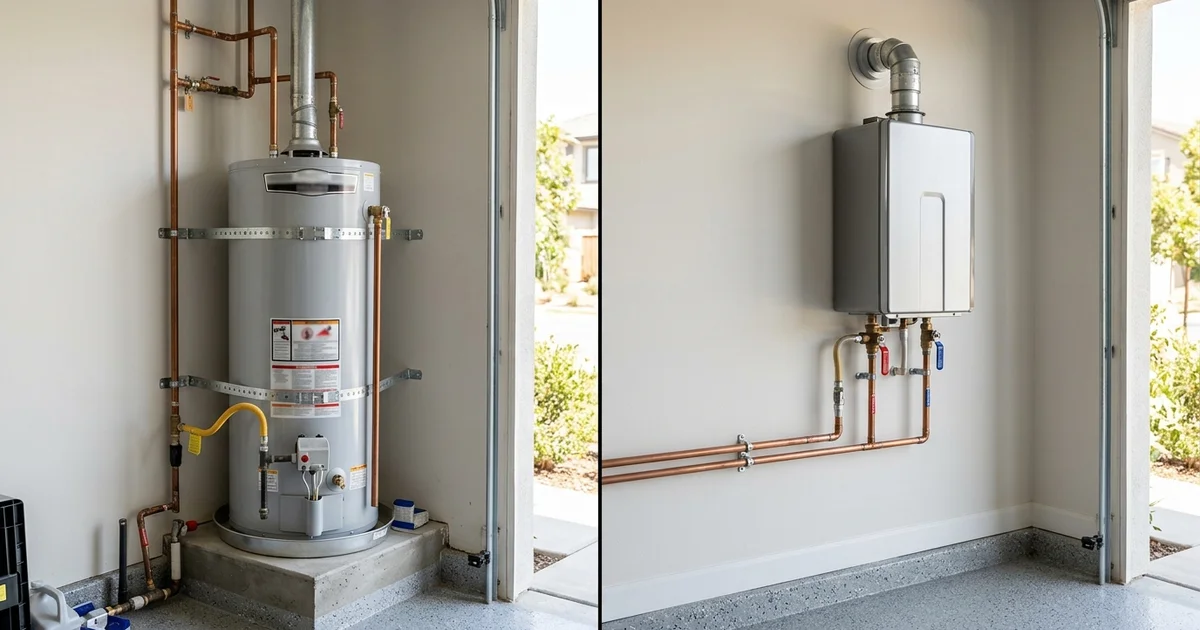
Tank or Tankless: The Short Answer
We hear the same frustration every day from local homeowners trying to choose a tank vs tankless water heater. Making the switch to an on-demand system solves the problem of lukewarm morning showers.
This upgrade requires a careful look at your specific home. We are tankless water heater experts in Southern California. The goal is to help you find the most reliable system for your daily routine.
Let’s examine the real trade-offs, explore what the 2026 data actually tells us, and walk through the exact factors you should consider.
Upfront Cost vs Lifetime Cost
Upfront, a tankless water heater costs significantly more than a standard storage tank. A typical conversion in Southern California runs between $4,500 and $7,500 installed, including the code-required venting and gas line upgrades.
Our tankless installation cost guide breaks down the specific factors driving this tankless vs tank cost difference. Replacing a tank with another tank is always cheaper on day one.
The lifetime picture reveals a completely different story.
- Lower operating cost: Tankless units do not keep 50 gallons of water hot continuously. You avoid standby heat loss, saving a typical household over $100 annually based on 2026 utility rates.
- Longer service life: The U.S. Department of Energy reports that tankless systems regularly last 20 years or more. A traditional tank usually needs replacing every 10 to 15 years.
- High-value incentives: SoCalGas offers rebates on qualifying high-efficiency units, usually based on the Uniform Energy Factor (UEF). Check current amounts before you buy.
We always advise checking local utility programs before buying. Checking the SoCalGas rebates guide covers all the current incentives to help lower your net cost. Busy households see the financial payback much faster due to heavy daily usage.
Endless Hot Water vs Recovery Time
A tankless system provides continuous hot water, eliminating the dreaded cold shower entirely. Traditional tanks have a fixed volume and require a 30-minute recovery period once depleted.
This limitation is the primary reason most homeowners make the switch. A 50-gallon tank drains surprisingly fast when you run back-to-back showers or fill a soaking tub. Once that stored supply is gone, you are left waiting for the burner to catch up.
We size tankless units to match your specific peak demand. A correctly sized system keeps heating the flow indefinitely, ensuring the fourth shower of the morning feels just as hot as the first. The critical metric here is Gallons Per Minute (GPM).
Insider Tip: Sizing is the most common pitfall in tankless conversions. An undersized unit will fail to keep up if someone flushes a toilet or starts a dishwasher while you are showering. This happens because the incoming ground water is colder during winter months, forcing the heater to work harder.
Our sizing guide explains exactly how to calculate the correct GPM for your home.
Space Savings
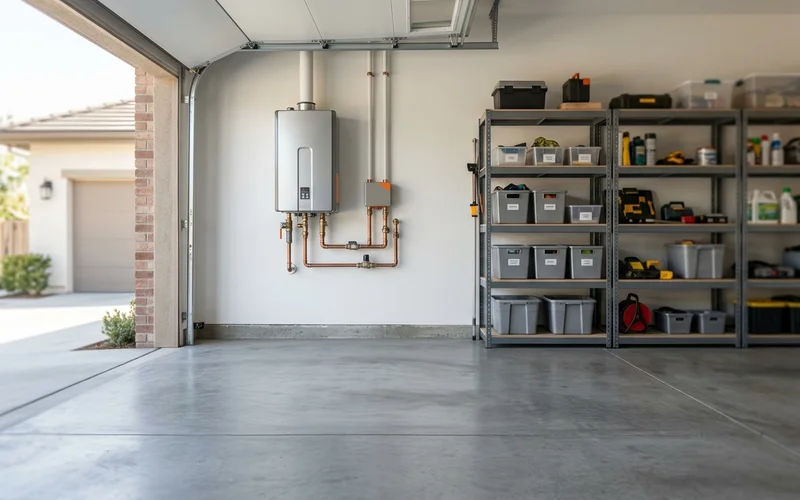
Switching to a tankless unit reclaims significant floor space in your garage or utility closet. These modern systems mount directly to the wall and are roughly the size of a standard carry-on suitcase.
We frequently see 50-gallon tanks dominating valuable real estate inside Southern California homes. Removing that bulky metal cylinder immediately opens up the room. In older architectural styles, this reclaimed square footage is highly prized.
For example, classic Craftsman bungalows in Pasadena or pre-war houses in Santa Monica often have extremely tight utility closets. Upgrading to a wall-mounted Navien or Rinnai unit creates enough room to install a stacked washer and dryer. You gain functional living space without expanding your home’s footprint.
The SoCal Hard-Water Trade-Off
Tankless units are significantly more sensitive to hard water than standard storage tanks. You must commit to regular descaling to protect the internal components and maintain efficiency.
We see the effects of this regional water quality every day. Southern California water is notorious for high mineral content, with areas like Pasadena and Los Angeles routinely measuring between 12 and 18 Grains Per Gallon (GPG). This “very hard” water creates scale rapidly inside the unit’s heat exchanger.
Ignoring this buildup reduces water flow, lowers heating efficiency, and ruins the system years ahead of schedule. The solution is straightforward but requires consistent attention.
Maintenance Costs and Schedules
You need to budget for professional maintenance as part of owning an on-demand system. A basic chemical flush clears out the mineral scale and costs about $200 to $250.
Our recommended full-service maintenance runs roughly $479. This comprehensive tune-up includes cleaning the combustion fan, inspecting the flame rod, and calibrating the gas pressure. Annual service is the mandatory baseline for most local cities. Homes in extreme hard-water zones might even need a flush every eight to ten months.
Factor maintenance into the decision
A traditional tank needs very little routine care until it eventually leaks and fails. A tankless unit requires periodic descaling, but it rewards you with better efficiency and a much longer lifespan. Skipping this maintenance will ruin the investment, so you must factor this ongoing cost into your choice.
Side-by-Side Comparison
The table below provides a direct comparison between traditional tanks and modern tankless systems. Reviewing these specific factors helps clarify which upgrade best fits your household needs and budget.
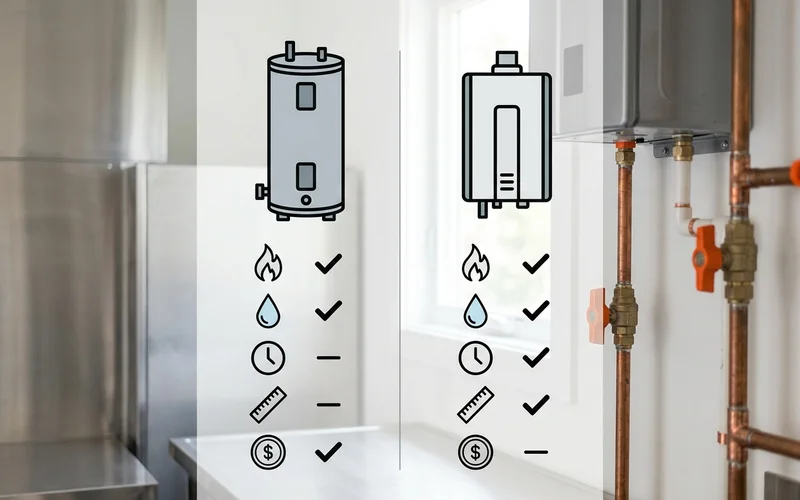
| Factor | Tank water heater | Tankless water heater |
|---|---|---|
| Upfront installed cost | Lower, usually a simple swap | $4,500-$7,500 typical conversion |
| Hot water supply | Limited to tank volume, then 30-min wait | Continuous flow within GPM capacity |
| Standby energy loss | Yes, constant reheating 24/7 | None, operates only on demand |
| Space requirement | Floor-standing, takes up 4-6 square feet | Wall-mounted, suitcase-sized footprint |
| Typical service life | 10-15 years; tank eventually rusts | 20+ years with proper maintenance |
| Routine maintenance | Minimal until failure | Annual flush required (critical in 12-18 GPG hard water) |
| Gas line demand | Roughly 40,000 BTU | Up to 199,000 BTU |
| Venting | Standard metal flue | Stainless, PVC, or concentric venting |
| Financial Incentives | Rarely eligible | High-UEF models may qualify for SoCalGas rebates |
Common Concerns About Switching
Most homeowners planning a switch to tankless worry about wait times for hot water and the disruption of the installation process. The reality is that delivery speeds are nearly identical to traditional tanks, and standard conversions only take a single working day.
We hear several common questions during our initial home visits. Here are the facts regarding the most frequent concerns.
Hot Water Delivery and Outages
“Will I wait longer for hot water?” You will barely notice a difference. The modern unit takes just a few seconds to detect flow and ignite the burner. The main wait time comes from the cold water already sitting in your home’s plumbing between the heater and the faucet. Installing a recirculation pump can drastically shorten this wait for distant bathrooms.
“What happens in a power outage?” Gas tankless units require electricity to operate their internal computer, fan, and electronic igniter. The system will stop working during a blackout. A standard gas tank uses a standing pilot light and continues heating without electrical power. You should factor this in if your neighborhood experiences frequent grid failures.
Installation and Everyday Use
“Is the install disruptive?” Almost all tank-to-tankless upgrades are completed within an eight-hour window. Your household will only be without hot water for a few hours during the actual swap. The required city safety inspection happens on a separate day. The conversion guide linked at the end of this page walks you through every step of a typical install day.
“Will it work with low-flow fixtures?” Modern units handle low-flow showerheads perfectly, provided the total draw stays above the heater’s minimum activation threshold. Dropping a faucet to a tiny trickle of mostly cold water might cause the burner to shut off. Standard household usage rarely triggers this issue.
“Do I need to change anything else in the house?” Upgrading usually requires a larger gas line, specific high-efficiency venting, and a dedicated electrical outlet near the mounting location. These necessary modifications are always included in a professional installation quote.
Who Should Stay With a Tank?
Tankless water heaters are not the perfect solution for every single property. A traditional tank makes more financial sense if your home requires extreme utility upgrades or your daily hot water usage is minimal.
We occasionally advise customers against making the switch. A good professional recommendation sometimes involves talking you out of an expensive upgrade.
Here are the most common scenarios where sticking with a conventional tank is the smartest choice:
- Prohibitive gas upgrades: Your gas meter or interior piping would need a massive, costly overhaul to support a 199,000 BTU tankless unit.
- Venting nightmares: Your home’s architecture lacks a practical, code-compliant route to install the required PVC or stainless steel exhaust venting.
- Healthy existing equipment: Your budget is currently tight, and your existing 50-gallon tank is still operating efficiently without leaks.
- Low household demand: Your family uses very little hot water, making it impossible to recoup the higher upfront costs through energy savings.
Our technicians evaluate all these factors during the initial estimate. Homeowners often ask us, are tankless water heaters worth it? You will always get an honest assessment of whether the conversion makes financial sense for your specific home.
Making the Switch
If you are ready to upgrade, the first step is scheduling a professional assessment of your plumbing and gas systems. A proper installation process will get your new endless hot water system running efficiently.
We follow a simple upgrade path:
- Virtual Estimate: Fast pricing based on photos of your current setup.
- In-Home Verification: Confirming gas and venting requirements in person.
- Installation: Most residential conversions wrap up in a single working day.
Scheduling the tankless water heater installation starts with that virtual estimate to protect you from surprise costs.
Are you curious about what to expect when the crew arrives?
Read the tank-to-tankless conversion guide for a complete breakdown of the timeline.