SoCalGas and California Rebates for Tankless Water Heaters
Utility and state incentive types, federal tax credit eligibility and documentation needed to lower the net cost of a tankless upgrade.
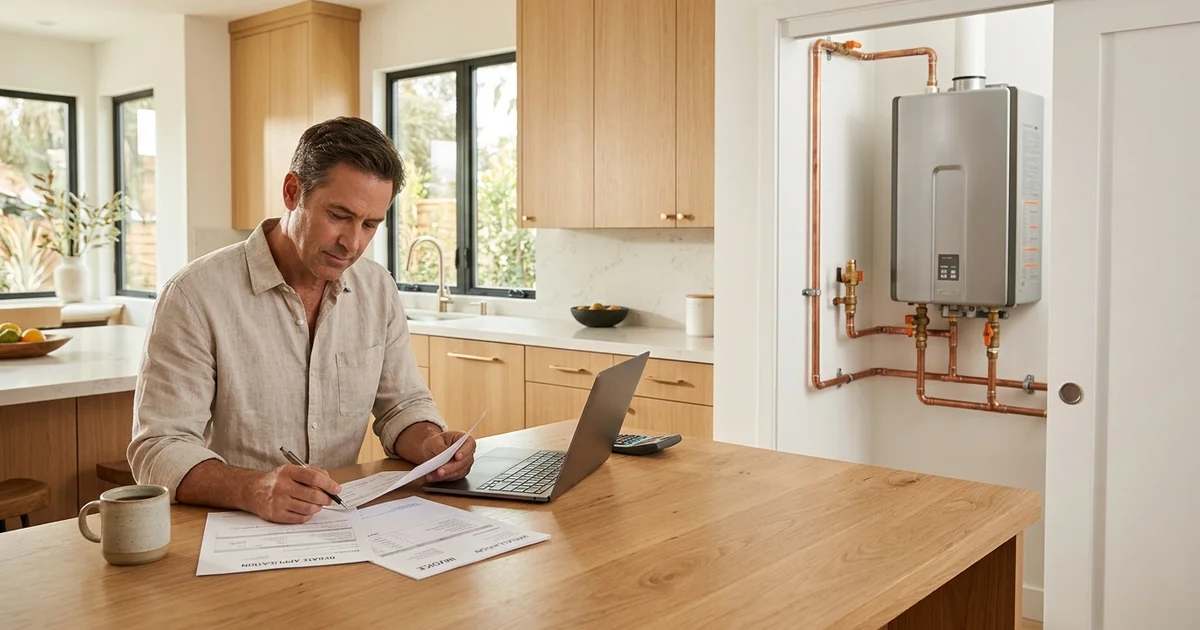
We see it all the time with smart homeowners looking to maximize their investments. Deciding on an appliance upgrade almost always comes down to the final, out-of-pocket price. Our team regularly tracks local utility funds to help clients find the best financial path forward.
Securing a SoCalGas tankless water heater rebate can take a massive bite out of your total project expenses.
We will review the most current data on local funding, explain what specific efficiency numbers mean, and show you exactly what paperwork you need to claim your money. You will have a clear roadmap to the best available savings right now.
Can You Get a Rebate on a Tankless Water Heater?
Yes, you can absolutely secure a rebate for a high-efficiency tankless water heater in 2026. Utility companies and federal tax rules currently offer incentives that significantly reduce the net cost of a tankless water heater installation.
Our installers find that these financial programs change constantly based on available regional budgets. Incentive amounts rise and fall, qualifying model lists undergo frequent updates, and popular funds run dry quickly.
Because these variables shift so rapidly, focusing on the core rules of application is the best strategy. We want you to understand exactly how the system works and what specific documents secure your payout. This preparation ensures you never miss an opportunity to lower your total costs.
Types of Incentives
You will find three main categories of financial incentives for water heaters, including local utility rebates, state programs, and federal tax credits. Each option carries its own specific qualification rules and strict filing deadlines.
Utility rebates
SoCalGas offers rebates on qualifying high-efficiency natural gas models through its residential programs. Amounts and qualifying tiers (often tied to the unit’s Uniform Energy Factor, or UEF) change, so check the current program terms before you buy.
A standard condensing unit with a UEF between 0.87 and 0.94 typically qualifies for a $900 payout. These utility offerings generally follow a strict set of rules.
- Offers are restricted to active customers in the specific utility service territory.
- Payouts require replacing a conventional natural gas tank-type water heater.
- Applications demand proof of installation within a strict post-purchase timeframe.
- Funds are disbursed only after you submit a complete application packet.
We highly recommend checking the current SoCalGas residential portal before you purchase any equipment. Getting pre-approval or verifying active funds ensures your chosen model qualifies for the cash.
State and regional programs
California manages various energy-efficiency funds through statewide and regional agencies. The state has heavily shifted its focus toward electric heat pump models for the 2026 calendar year.
Our research shows that popular initiatives like the TECH Clean California program currently have their single-family funds fully reserved or waitlisted. Securing a California tankless rebate requires careful timing due to this high demand.
You should always verify active waitlist status on the state website during your early planning phase.
Federal tax credits
The Section 25C energy efficient home improvement credit used to cover 30% of a qualifying gas water heater, up to $600. Under current federal law that credit ended for equipment placed in service after December 31, 2025, so most 2026 installs won’t qualify.
Federal rules can change, so check the current IRS guidance for your installation year with a tax professional before you count on any credit in your budget.
Check before you buy, not after
Many programs demand a qualifying model, pre-approval, or a strict application submission window right after installation. Verifying the terms beforehand stops you from missing out on money you could easily claim.
Qualifying Models and Efficiency Levels
Most utility and government programs mandate a minimum efficiency rating measured by the Uniform Energy Factor (UEF). You generally need a UEF of 0.95 or higher to hit the sweet spot for maximum federal and local returns.
Our daily installation work proves that condensing units easily meet these strict program benchmarks.
- Condensing tankless units boast high UEF ratings (often 0.95 to 0.98) and easily qualify for top-tier funds.
- Non-condensing units usually hover around 0.81 to 0.82 UEF, missing the threshold for federal credits and high-tier utility payouts.
- ENERGY STAR certification acts as the baseline qualifying standard for nearly all 2026 IRS tax benefits.
We factor these exact efficiency numbers into our estimates when you mention your rebate plans. Picking the right unit upfront saves you the headache of sorting through complex specification sheets later. Our condensing vs non-condensing guide breaks down the exact mechanical differences behind these efficiency ratings.
Documentation You’ll Need
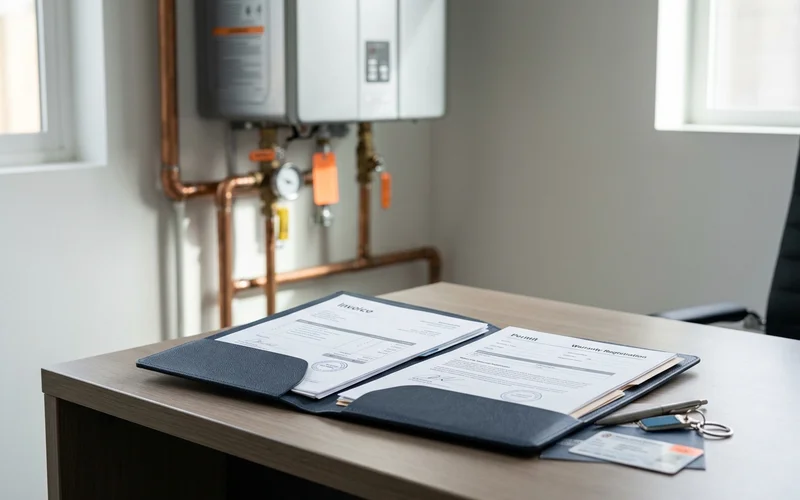
You must provide a pristine paper trail to secure any rebate or tax credit. Claiming these funds requires gathering very specific paperwork immediately after the installation is complete.
Our office staff compiles these exact forms for clients every single week.
| Document | Why you need it |
|---|---|
| Itemized invoice | Proves the exact unit, total price, authorized installer, and service date |
| Model and serial numbers | Verifies the unit is a specific, qualifying high-efficiency model |
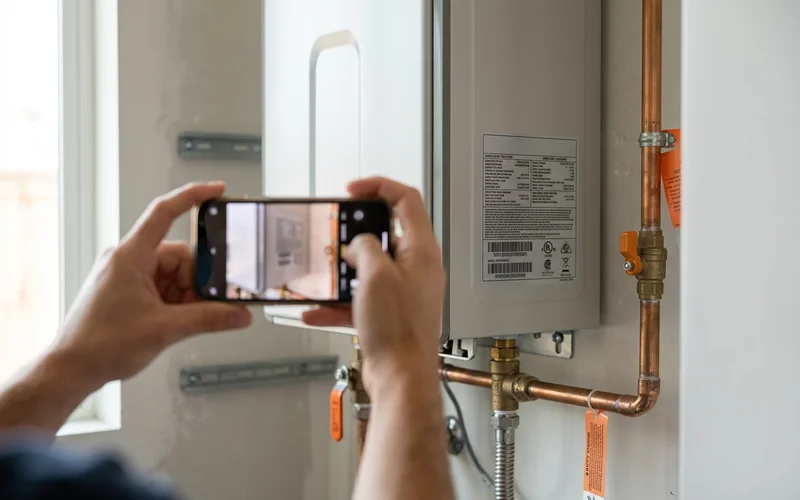
| Photo of the rating label | Provides direct visual proof requested by utility auditors |
| Account number and address | Confirms you reside in the active utility program service area |
| Manufacturer Certification | The specific AHRI certificate or MCS required by the IRS for federal claims |
| Permit or inspection record | Proves the equipment received a safe, compliant, legal installation |
We supply a detailed, itemized invoice displaying the exact model and serial numbers upon completion of every job. That way you have everything the rebate application asks for in one place.
How Incentives Fit Into Your Total Cost
A standard tank-to-tankless conversion currently costs between $4,500 and $7,500 before any financial incentives are applied. A utility rebate on a qualifying model lowers that net cost, so check what’s available before you choose a unit.
Our experts maintain that a rebate should never force you into buying the wrong system for your specific household. Getting the correct size and hot water capacity must always dictate your final decision. If two distinct models meet your exact plumbing needs, selecting the one with the highest financial incentive makes perfect sense.
You can view a complete breakdown of what drives these specific prices in our tankless installation cost guide.
Common Rebate Mistakes to Avoid
Homeowners lose out on perfectly valid incentives every day due to simple administrative errors. Avoiding these frequent traps keeps your application moving smoothly through the approval pipeline.
Our support team sees the same easily preventable issues pop up year after year.
- Buying first, checking later. Many homeowners install a unit, only to learn its 0.82 UEF misses the 0.95 program requirement. You must confirm the exact model qualifies before the tools come out.
- Missing the deadline. Utility companies enforce strict post-installation submission windows. Marking your calendar on the day the installation finishes prevents this costly mistake.
- Incomplete paperwork. Failing to include a photo of the rating label will stall your application for weeks. You need an itemized invoice that clearly lists both the model and serial numbers.
- Assuming a program is still running. State funds often run dry mid-year, and waitlists form quickly. The massive incentive you read about last December might not have funding today.
- Wrong account details. Utility portals tie applications directly to the registered service address. You must submit the application using the exact name listed on the monthly gas bill.
- Ignoring IRS changes. Federal regulations change rapidly depending on the active tax year. You should confirm current IRS Form 5695 rules with your accountant before spending your budget.
Who handles the application?
The homeowner almost always handles the final submission because the payout connects directly to their personal utility account. Processing times with companies like SoCalGas currently take about 6 to 8 weeks before a check arrives in the mail.
We simplify this waiting period by handing you a clean, itemized invoice with all required dates and numbers. If a specific local program allows or requires contractor submission, our team will handle that detail and inform you during the initial estimate.
A Simple Rebate Checklist
You can confidently secure your incentives by following a straightforward, step-by-step verification process. This quick checklist ensures you have every base covered before the installation begins.
Our technicians recommend keeping this list handy during your initial equipment selection.
- Review current SoCalGas and state waitlist statuses before selecting a final model.
- Verify that your chosen unit meets the 0.95 UEF mark for maximum federal benefits.
- Gather your itemized invoice, rating label photos, and AHRI certificate immediately after install.
- Submit your utility application online to avoid missing the tight post-purchase deadline.
- Ask your tax professional whether any federal credit applies for your installation year.
When hunting for energy rebates, water heater upgrades often provide the highest return on investment. You can send us photos of your current setup for a free virtual estimate. We will factor all active local incentives into our final recommendation when you mention your specific financial goals.