Does a Tankless Water Heater Need a Bigger Gas Line?
Why a tankless unit can draw up to ~199,000 BTU vs ~40,000 for a tank, when 1/2-inch lines fall short, and how it affects your quote.
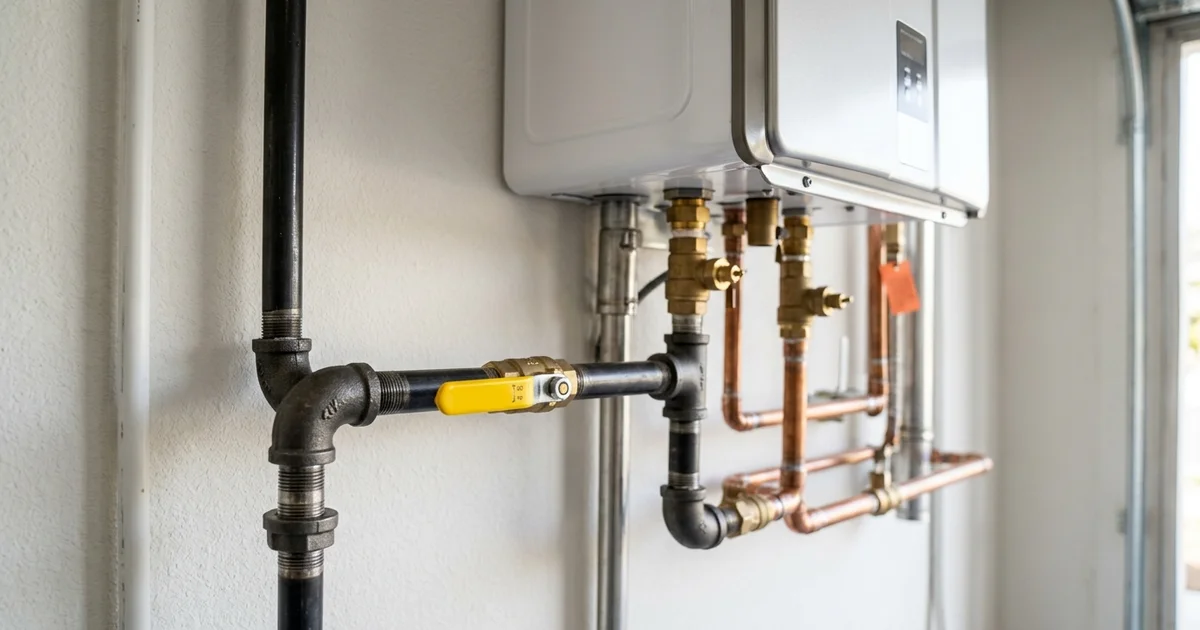
You know how a sudden cold shower ruins your morning routine. We often see homeowners caught off guard by hidden plumbing challenges during an upgrade, especially concerning the tankless water heater gas line size.
The gas supply is the single biggest hurdle separating a standard hot water setup from a truly endless supply.
Our technicians consider correct gas sizing a mandatory part of every tankless water heater installation we complete. Let us look at the real data and explore exactly what an upgrade entails.
Why Tankless Units Need So Much Gas
Tankless water heaters require a massive amount of fuel instantly to heat water on demand. A standard system stores hot water, while an on-demand unit must flash-heat cold water immediately. We constantly explain that a typical gas storage tank only uses a burner of roughly 40,000 BTU.
It heats slowly over time and holds the temperature. Our installations for whole-home systems require much larger burners, often reaching up to 199,000 BTU at full fire.
Modern high-efficiency models, like the Navien NPE-240A2 or Rinnai RUR199i, demand these peak energy levels. We see units starve for gas when the existing pipe cannot deliver this five-fold increase in fuel flow, causing immediate problems:
- Ignition failures triggering Rinnai Error Code 11 or Noritz Error Code 11 alerts.
- Sudden flame loss during periods of high demand.
- Lukewarm water instead of the hot temperatures you expect.
A starved system will simply shut down and deny you hot water. Our service calls frequently reveal these complete ignition failures due to low gas pressure.
1/2-Inch vs 3/4-Inch Tankless Water Heater Gas Line Size
Most traditional tanks use a 1/2-inch gas branch, but a 3/4 gas line tankless setup is almost always required. The final pipe size depends heavily on the total distance from the meter and the specific material used.
We evaluate four specific factors to determine if your existing pipe has enough capacity. The California Plumbing Code (CPC) dictates these sizing requirements based on exact flow rates. Our assessment looks at the following elements to ensure safe operation:
- The unit’s BTU input: A higher rating demands significantly more cubic feet per hour (CFH).
- The length of the run: Gas loses pressure over distance from the meter to the heater.
- Fittings and bends: Each 90-degree elbow and T-junction adds friction and resistance.
- Other appliances on the same line: Your furnace, range, dryer, and fireplace all pull from this shared supply.
We always check the pipe material because a 1/2-inch Schedule 40 black iron pipe carries different volumes than flexible corrugated stainless steel tubing (CSST). A 60-foot run of standard 1/2-inch black iron pipe maxes out around 73 CFH.
Our technicians know this falls dramatically short of the 199 CFH required by a large whole-home unit. Plumbing codes utilize sizing tables that strictly combine BTU load and pipe length. We find that a short 1/2-inch run feeding only the water heater might work for a small unit, but a long shared run never does.
| Situation | Likely outcome |
|---|---|
| Short run, smaller unit, no other appliances on the branch | Existing 1/2-inch line may be enough after calculation |
| Moderate run, whole-home unit | New 3/4-inch line from the meter is common |
| Long run or many appliances on the same supply | Larger pipe or a dedicated line may be needed |
| Meter cannot supply the total household load | Utility meter upgrade may be required |
Gas Meter and Regulator Capacity
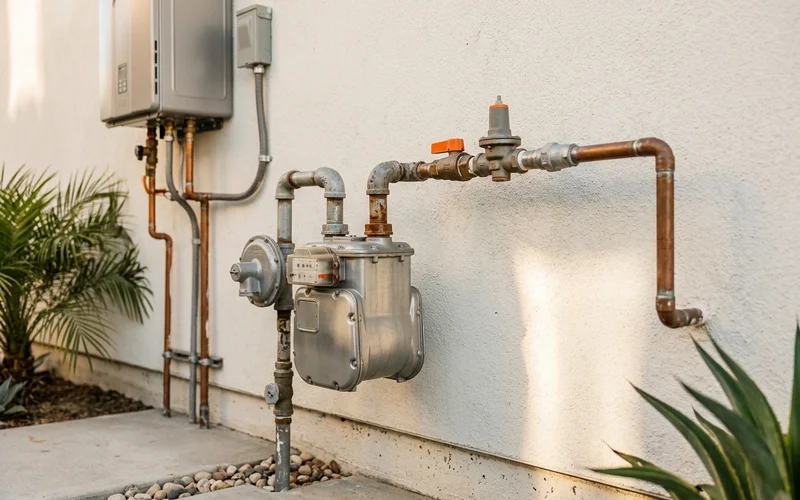
Your gas meter and its regulator have a strict limit on the maximum flow they can provide to your home. The physical pipe diameter is useless if the main utility meter cannot supply enough total fuel.
We must calculate the total load by adding up every single gas appliance in the house:
- The new tankless unit (up to 199,000 BTU).
- The central heating furnace.
- The kitchen range and oven.
- Gas clothes dryers or pool heaters.
A new 199,000 BTU water heater paired with an 80,000 BTU furnace easily exceeds that limit. When evaluating gas meter capacity, tankless systems often push the limits of what older homes can provide. Our standard checks in Southern California reveal that a typical older SoCalGas residential meter often provides only about 250 CFH, or 250,000 BTU.
Appliances aggressively compete for fuel when they run simultaneously on an undersized meter. We immediately notify you if the gas utility must step in to install a larger meter in these situations.
This specific upgrade is handled entirely by the utility company, not by private plumbers. Our team checks the meter rating during the initial estimate so you know about this potential delay early.
Don’t skip the gas calculation
An undersized gas supply is one of the most common causes of ignition and flame-loss codes on newly converted tankless units. It can also void warranty coverage. Proper sizing up front prevents both.
How Gas Work Affects Your Installation Quote
Modifying your fuel supply for a tankless gas line upgrade is a primary reason a conversion falls into the typical $4,500 to $7,500 range. The complexity of routing new pipes directly impacts the total labor and material costs.
We break down the specific factors that drive this expense for every property. Several key elements influence the final price of your project:
- Run length and route: A garage heater located a few feet from the meter remains simple. A closet heater on the far side of a house with a long attic or crawlspace route requires more time and material.
- Pipe material: Black iron and approved flexible gas tubing both have their place based on the route and local codes.
- Access: Finished walls, older homes, and tight crawlspaces require intense labor.
- Shutoffs and protection: A new appliance shutoff valve, a sediment trap, and required seismic gas shutoff measures add to the total.
- Permit and inspection: City inspectors review the fuel line work alongside the water heater itself.
Our quotes explicitly list any mandatory safety devices required by local municipalities. For example, the City of Los Angeles enforces Ordinance 171874, which mandates a state-certified earthquake gas shutoff valve for new permits.
We install these valves to automatically trigger and stop fuel flow during a 5.4 magnitude or higher seismic event. Mandatory upgrades like these ensure full compliance and protect your home from post-earthquake fires.
Our detailed estimates include all required upgrades upfront so you experience no surprises on installation day. Read the complete tankless installation cost guide for a breakdown of other price drivers.
What We Check During Your Estimate
Accurate quoting requires a detailed look at your existing plumbing layout. Providing photos of your current setup helps identify potential bottlenecks immediately.
We ask you to send pictures of the exterior meter, the pipe reaching your current heater, and the rating label on the tank. This preliminary information allows a professional to determine if a major line replacement is highly probable.
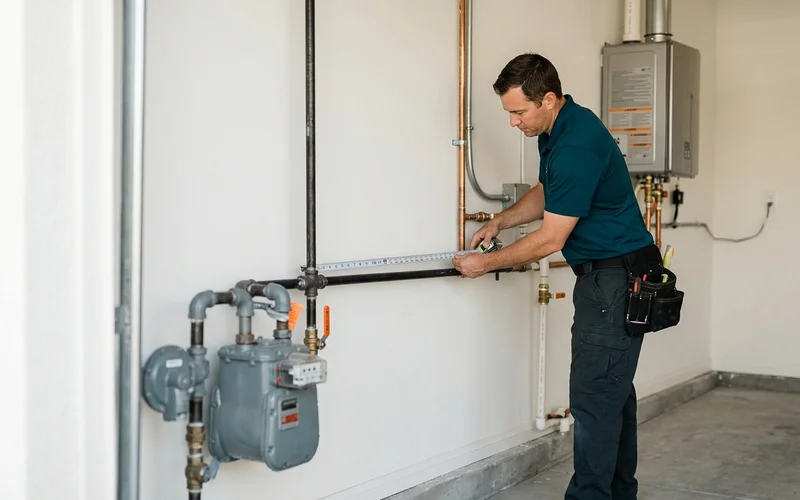
Our technicians perform a thorough verification during the in-home consultation to finalize the plan. An accurate physical inspection includes several critical measurements:
- Measure the exact run from the exterior meter to the proposed heater location.
- Count the fittings, elbows, and other appliances drawing from the same supply.
- Check the total capacity rating on the utility meter.
- Confirm the new unit’s BTU input and size the line according to current code.
- Perform a dynamic gas pressure test using a digital manometer to ensure pressure does not drop below 3.5 inches of water column.
We provide a clear layout of exactly what will happen on the day of service.
If you are planning a full conversion, the step-by-step tank-to-tankless conversion guide shows exactly where this piping work fits into the schedule. Our team recommends finalizing your equipment choice early to simplify the planning process.
Start by reading what size tankless water heater you need, since the physical unit capacity absolutely dictates your final tankless water heater gas line size requirement.