What Size Tankless Water Heater Do I Need?
Add up fixture flow rates, factor in SoCal inlet temperatures and BTU input to estimate the right tankless size before your quote.
If you are wondering, “what size tankless water heater do i need,” you are asking the exact right question for the 2026 upgrade market.
From what we have seen in Southern California homes, sizing is the single biggest factor separating a flawless, endless hot water system from a frustrating one.
The 2025 Title 24 code changes made energy efficiency even more critical. Getting the capacity right is still step one.
Sizing Starts With Two Numbers
Tankless water heaters are not sized by gallons of storage like traditional tanks. They are sized by flow (how many gallons per minute you need at once) and temperature rise (how much the unit has to heat the incoming water).
Get those two right, and the rest follows.
We prioritize these calculations first for every tankless water heater installation. This guide shows you exactly how to estimate it yourself so you walk into your quote knowing what to expect.
Step 1: Add Up Your Simultaneous Fixture Flow (GPM)
Start by listing the fixtures running simultaneously during your busiest morning and adding their maximum flow rates. Think about a typical weekday morning in your home. What hot water is running at the exact same time?
Our team always references the latest California Green Building Standards Code (CALGreen) to calculate peak demand accurately. State mandates updated for 2026 restrict new showerheads to a maximum of 1.8 gallons per minute (GPM) at 80 psi. Kitchen faucets are also capped at 1.8 GPM, while residential bathroom faucets must stay at or below 1.2 GPM.
Older fixtures installed before these efficiency mandates often use much more water. We recommend checking your showerhead for a small GPM stamp near the threaded connection to verify its flow rate.
Typical hot-water flow rates look like this:
| Fixture | Typical flow (GPM) | Notes |
|---|---|---|
| Shower (California-compliant head) | 1.5, 1.8 | Older heads may run 2.5 or more |
| Bathroom faucet | 0.5, 1.2 | Usually short use |
| Kitchen faucet | 1.5, 1.8 | |
| Dishwasher | 1.0, 1.5 | Draws in short cycles |
| Clothes washer (hot cycle) | 1.5, 2.0 | Many loads now use mostly cold |
| Soaking tub | 4.0 or more | Tub fillers can drive sizing on their own |
Example: Two showers (1.8 + 1.8) plus a kitchen faucet (1.5) adds up to about 5.1 GPM of peak demand.
Keep in mind that hot water is usually mixed with cold water at the fixture itself. The true hot-water demand is slightly lower than the full fixture rate. Using the full 5.1 GPM rate builds in a sensible safety margin for peak winter days.
Pro Tip for Custom Showers Luxury bathroom remodels with thermostatic diverter valves and multiple showerheads can easily push demand past 4.0 GPM on their own. These custom setups frequently require a dedicated secondary heating unit.
Step 2: Find Your Temperature Rise
Temperature rise is the exact difference between your incoming groundwater temperature and the temperature you want at the tap. Most households set their unit around 120°F.
Your inlet temperature depends heavily on where you live and the season. We see significant variations across Southern California depending on the exact geography.
- Coastal areas like Santa Monica stay relatively mild year-round, with winter inlet water holding around 60°F to 62°F.
- Inland valleys like the Conejo Valley and much of Orange County see colder winter inlet water, often dropping to 55°F.
- The high desert around Lancaster and Palmdale sees the coldest inlet water in winter, regularly hitting 45°F.
Subtract your winter inlet temperature from your 120°F target to find your required rise. A 45°F inlet in the high desert requires a 75°F temperature rise to reach a comfortable shower temperature.
A unit that handles your peak demand in January will remain comfortable all year. Homeowners often make the mistake of calculating their rise using 70°F summer water temperatures. This simple oversight guarantees lukewarm showers when the weather gets cold.
Why your neighbor’s unit size may not fit you
The same tankless model delivers fewer gallons per minute in Lancaster in January than in Torrance in July. Sizing from a friend’s house in another part of SoCal can leave you short.
Step 3: Translate GPM and Rise Into BTU
To find your required heating capacity, use the standard mathematical formula. Multiply your GPM by your temperature rise, and then multiply that result by 500. This calculation gives you the exact British Thermal Units (BTU) of output needed per hour.
The Standard Sizing Formula
BTU per hour of output ≈ GPM × 500 × temperature rise (°F)
Using the example above, 5.1 GPM × 500 × 65°F equals about 166,000 BTU of output. Unit ratings list BTU input, and a unit’s efficiency determines how much of that gas actually becomes heat in the water.
Our technicians frequently install high-efficiency condensing units like the Navien NPE-240A2 or the Rinnai RU199iN for busy SoCal households. These 2026 models feature a 0.95 Uniform Energy Factor (UEF). This stellar rating means they convert 95% of their 199,000 BTU input directly into hot water.
Non-condensing units convert a bit less of their fuel into heat. Premium whole-home systems typically max out around that 199,000 BTU input limit to accommodate these specific efficiency differences.
Reading Manufacturer Flow Charts
You can flip the formula around to see what a given unit can do. A unit putting out about 189,000 BTU to the water at a 65°F rise delivers roughly 5.8 GPM. At a 50°F rise, that same unit pushes closer to 7.5 GPM.
Manufacturers publish these flow-at-rise charts for every single model. We use these specific charts during every consultation to verify the math perfectly.
A Simple Sizing Worksheet
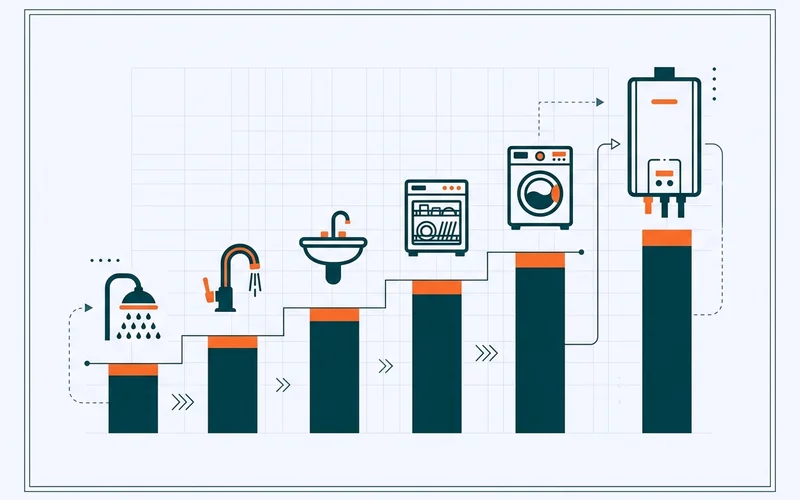
Grab a pen and use this quick worksheet to estimate your required system capacity. Fill in the blanks with the data you gathered in the previous steps.
- List your peak fixtures: Which ones run at the same time on your busiest morning?
- Add their GPM: Use the table above. Total = ____ GPM.
- Estimate winter inlet temperature: Coastal, inland or high desert? ____ °F.
- Subtract from your set point (usually 120°F): Temperature rise = ____ °F.
- Multiply: GPM × 500 × rise = ____ BTU of output needed.
- Compare to model charts: Pick a unit that delivers your GPM at your rise.
If your result is beyond what one residential unit can handle, two units can be linked to share the load. This is a common requirement in large custom homes with high-flow soaking tubs.
We always add a 5% margin to account for heat loss through the home’s plumbing. Factoring in this buffer guarantees consistent performance across the entire house.
Signs a Unit Is Undersized
The most obvious sign of an undersized system is a sudden drop in water temperature when a second tap opens. If you already have a tankless unit, these are the primary clues it lacks the capacity for your home:
- Water turns lukewarm when a second shower or the dishwasher starts.
- Problems are much worse in winter than in summer.
- You have had to turn down the flow to get hot water.
- The unit runs at maximum fire for long stretches.
Running at maximum fire constantly will drastically shorten the lifespan of the internal heat exchanger.
Scale buildup can cause similar symptoms by restricting water flow and reducing heating capacity. Hard water is notoriously tough on plumbing in areas like Ventura County.
We recommend ruling out mineral deposits with a standard maintenance flush before assuming the unit is too small. Read the guide on why a tankless goes cold mid-shower to explore the other common causes in detail.
Sizing Affects Your Gas Line and Venting
Upgrading to a high-capacity tankless system almost always requires modifying your existing utility connections. Bigger units need significantly more gas to meet peak demand safely.
A standard storage tank uses around 40,000 BTU of gas. A premium tankless unit draws nearly 199,000 BTU, requiring a much larger volume of fuel instantly. Many residential conversions require an immediate gas line upgrade from a 1/2-inch pipe to a 3/4-inch pipe to handle this surge.
Our guide to tankless gas line size explains exactly how that process works in detail.
Understanding Venting Requirements
Higher input limits can also change your venting configuration. Modern condensing units use standard PVC or CPVC piping because their exhaust is relatively cool. Older non-condensing models required expensive Category III stainless steel venting.
We never size a unit in isolation based just on plumbing fixtures. During your estimate, a technician will evaluate your household demand, inlet conditions, the gas meter, the line, and the vent route together.
Send us photos and a list of your bathrooms and fixtures for a free virtual estimate. The team will tell you exactly what size fits your home and what it will take to complete the installation.