Commercial Tankless Water Heater Systems for Restaurants and Multi-Unit Buildings
How manifold tankless systems serve restaurants and multi-family buildings: demand sizing, redundancy, maintenance and code considerations.
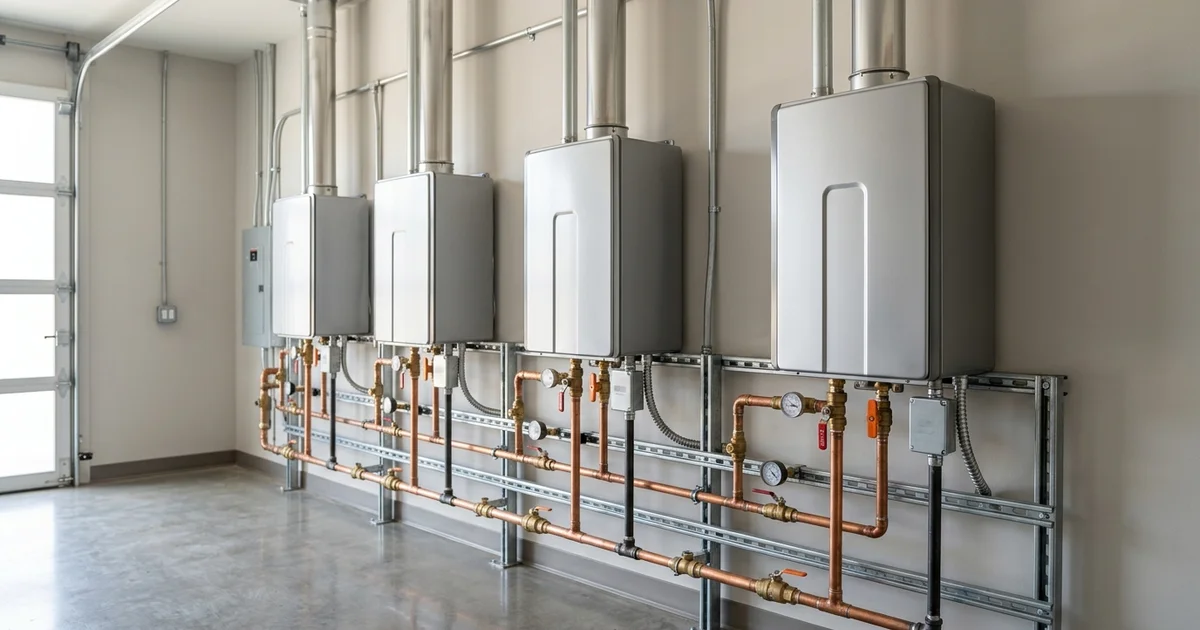
Replacing a massive boiler with commercial tankless water heater systems is a major decision for any property owner. Our team sees this upgrade as a critical strategy for protecting facility uptime and controlling long-term operating costs.
Standard 100-gallon commercial tanks waste significant standby energy, and a single failure can shut down an entire building. We install and maintain these high-efficiency solutions as tankless water heater specialists in Los Angeles.
Let’s look at the data on how a multi-unit tankless manifold solves these issues, review the sizing requirements, and explore exactly what to plan for with your commercial upgrade.
Why Businesses Use Manifold Tankless Systems
A single tankless unit is built for a home (see how a tankless water heater works for the basics). A restaurant kitchen, a salon, a gym, or an apartment building needs much more hot water, often all at once. Instead of one giant boiler or a bank of storage tanks, many commercial properties use a manifold system.
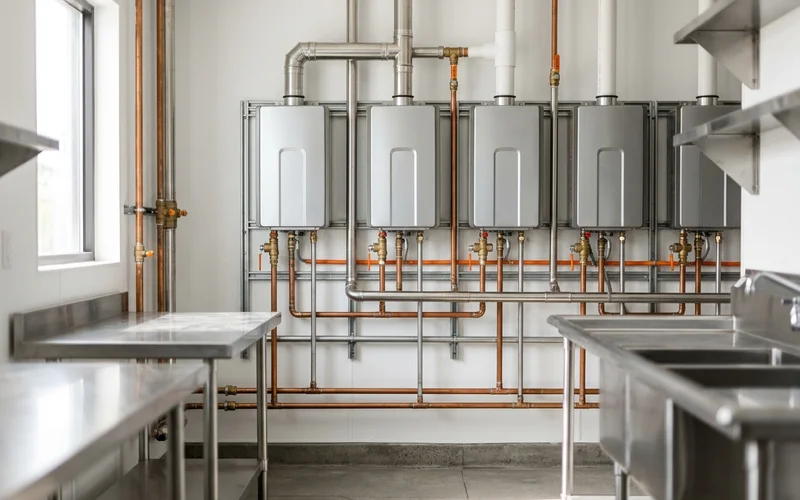
You might hear this called a tankless rack system. This setup features several tankless units plumbed together on common supply and return headers.
Our preferred brands, like the Rinnai Tankless Rack System (TRS) or the Navien Ready-Link Rack, deliver up to 97% thermal efficiency. These advanced systems drastically cut the standby energy waste associated with traditional 399,000 BTU commercial tanks. Let’s look at the main reasons businesses make the switch:
- Maximized efficiency: Units only fire when demand dictates, saving significant gas.
- Space reclamation: Wall-mounted racks free up valuable square footage in crowded utility rooms.
- Operating cost reduction: High thermal efficiency directly lowers monthly utility bills.
How a Manifold System Works
The units in a rack share a master controller or communicate with each other using cascade cables. When demand is low, only one or two units fire. As more taps open, more units come online automatically.
We rely on this staging mechanism because it provides incredible advantages for high-volume properties. This approach creates a highly responsive water heating network. Let’s look at the core benefits of this staged operation:
- Capacity scales with demand. Units fire only as needed, so a quiet afternoon does not burn the same gas as a dinner rush.
- Built-in redundancy. This is known as N+1 redundancy in the industry. If one 199,000 BTU unit needs service, the others keep running.
- Even wear. Controllers rotate which unit leads, so no single heater does all the work.
- Space savings. Wall-mounted units take far less floor space than massive storage tanks.
Redundancy is the selling point
For a restaurant, losing hot water can mean closing for the night under health rules. A rack with multiple units turns a single failure into a capacity dip instead of a shutdown.
Demand Sizing for Commercial Kitchens and Multi-Family Buildings
Calculating Flow and Temperature Rise
Commercial sizing starts the exact same way as residential planning. You add up the flow you need at the same time and the temperature rise you need to reach. The fixtures are just different.
Our sizing process accounts for specific regional requirements and peak usage times. California health codes enforce strict temperature minimums to prevent foodborne illness. For example, a 3-compartment sink in Los Angeles requires 110°F for washing and a scorching 171°F for hot water sanitizing.
We use high-capacity commercial condensing units, like the Rinnai C199, specifically because they can output water up to 185°F without a separate booster heater. This capability easily satisfies local health inspectors and keeps kitchens compliant.
Sizing by Property Type
| Property type | Typical demand drivers | Sizing considerations |
|---|---|---|
| Restaurant | Dish machine, hand sinks, prep sinks, mop sink | 171°F sanitizing temperatures require specific commercial units |
| Multi-unit apartments | Showers across many units at morning and evening peaks | Diversity factor determines true peak gallons per minute (GPM) |
| Salon or spa | Shampoo bowls, laundry | Steady all-day draw requiring continuous high flow |
| Gym or locker room | Many showers at once after classes | Short, intense peaks needing rapid BTU staging |
Restaurant equipment often has specific temperature requirements, and local health codes strictly enforce them. Multi-family buildings involve estimating how many units will draw hot water at the exact same moment.
Our technicians work through those exact numbers during the estimate. Gas supply and venting capacity are critical factors, since a large rack can draw over 1,000,000 combined BTUs at full fire.
Maintenance Schedules for High-Use Systems
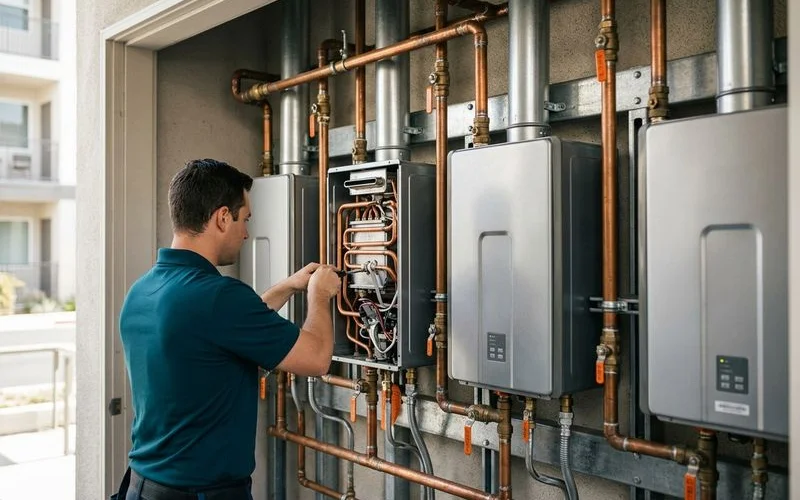
Commercial tankless units run many more hours than residential ones, so scale builds much faster. In hard-water areas across Southern California, regular descaling is absolutely essential.
We have seen untreated scale drop a commercial unit’s thermal efficiency by over 10% in a single year. A scheduled commercial maintenance plan prevents this energy loss and protects the equipment. Here is what a proper commercial maintenance protocol includes:
- Scheduled flushing: We use dedicated isolation valves to flush units with a descaling solution based on run hours and local water hardness.
- Combustion-side service: This covers fan cleaning, flame rod cleaning, and gas pressure checks.
- Rotation: By servicing one unit at a time, the building keeps hot water flowing without interruption.
- Records: Dated service reports for each unit are required for warranty claims and property management audits.
Our full-service maintenance covers all of these vital steps. You can see what each visit includes on our tankless water heater maintenance page.
Code and Venting Considerations for Commercial Installs
Meeting Local Regulations
Commercial installs bring extra planning, especially in highly regulated areas.
Our installation process manages these strict local codes from the very beginning. Southern California property owners face unique environmental regulations regarding emissions. The South Coast Air Quality Management District (SCAQMD) enforces strict rules on gas-fired equipment.
Currently, gas water heaters must meet ultra-low NOx limits of 14 ng/J or 20 ppm. We strongly advise property managers to plan for SCAQMD Rule 1146.2. This rule mandates a phased transition to zero-emission standards for commercial water heaters starting in January 2026.
Infrastructure Requirements
Beyond emissions, the physical infrastructure requires careful engineering. Let’s review the primary infrastructure needs for a commercial rack:
- Gas supply. Several units at full fire need a high-capacity gas line and meter sized for the combined BTU load.
- Venting. Condensing units often allow for cost-effective Schedule 40 PVC or CPVC venting, but each unit needs an approved termination meeting clearance rules.
- Permits and inspections. Commercial work is strictly permitted and inspected, and many jurisdictions require structural engineering review for wall-mounted racks.
- Access. Racks must be mounted where technicians can easily reach the cascade cables, valves, and internal components.
Getting these details right at the initial install is far cheaper than fixing them later. Our tankless water heater installation service covers the gas, venting, and permit work completely.
The comprehensive guide to tankless venting explains these specific exhaust options in much more detail.
Is a Commercial Tankless System Right for Your Property?
A manifold tankless system is a strong fit when you need high hot-water volume, cannot afford downtime, and want to free up floor space. We find this setup solves the most stressful plumbing issues for busy facilities.
If you manage a restaurant, salon, or apartment building in Los Angeles, Orange, or Ventura County, we can help. Send us photos of your current water heating setup and a quick description of your demand for a free virtual estimate.
Our team will tell you what a restaurant tankless water heater setup would look like for your property and provide a written price range. Take control of your facility’s energy costs and reliability today.