Tankless Water Heater Repair vs. Replacement: How to Decide
Weigh unit age, warranty status, heat exchanger condition and repair cost vs a new install ($4,500–$7,500) to make the right call.
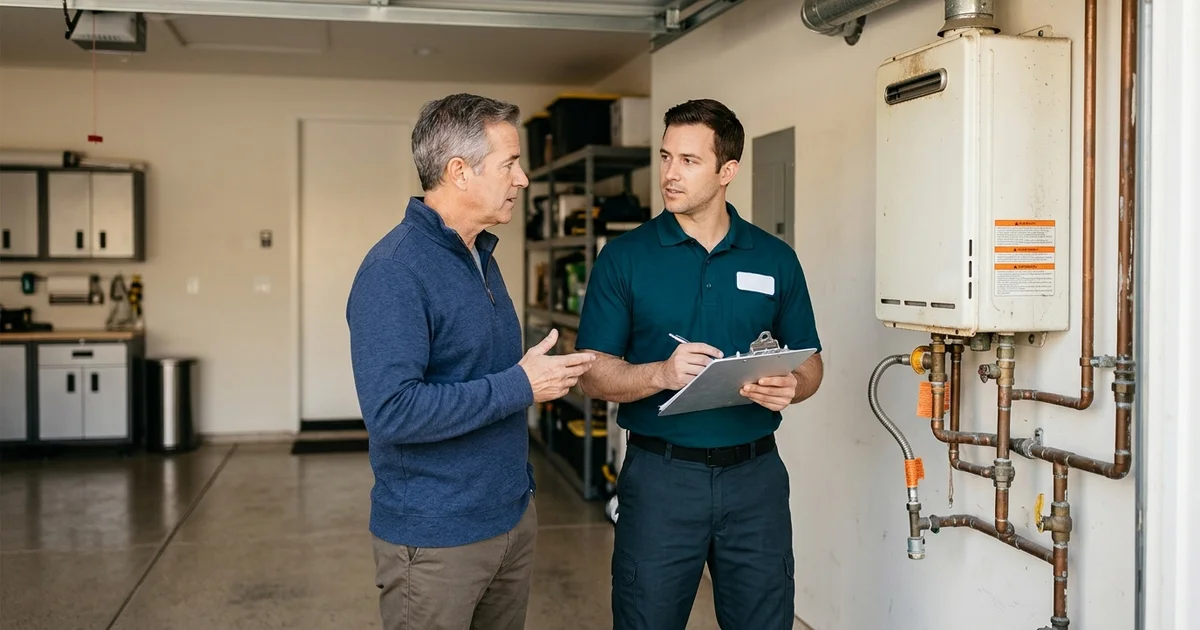
The Question Every Tankless Owner Eventually Faces
Southern California’s hard water forces many homeowners to weigh a tankless water heater repair or replace decision much earlier than expected.
A sudden loss of hot water is incredibly frustrating. The good news is that most modern on-demand systems are highly modular, meaning a single failed part does not doom the whole unit.
We diagnose the exact failure point before quoting any tankless water heater repair, making sure you understand the true costs. This upfront clarity protects your budget from unnecessary expenses.
Let’s examine the specific numbers and components you need to check before making your choice.
Factor 1: Unit Age
Age is the most critical starting point because it dictates parts availability and remaining service life. A standard on-demand water heater lasts roughly 15 to 20 years with proper maintenance.
We recommend comparing your unit’s age against this 20-year baseline. Systems from major brands like Rinnai and Navien typically perform very well during their first decade.
Knowing the exact age helps you quickly determine when to replace tankless water heater systems versus when to fix them. Older models require a much closer look to decide if a tankless repair worth it, especially if the fix is expensive.
Here is a quick look at how age impacts your decision:
- 0 to 8 years old: Repair is almost always the smartest financial choice.
- 9 to 14 years old: Compare repair costs against the price of a new installation.
- 15+ years old: Replacement is usually the most cost-effective path forward.
Your unit’s exact manufacturing date is printed on the side rating label or encoded directly into the serial number. You can just include a clear photo of this label when contacting a professional.
Factor 2: Warranty Status
You should always verify your warranty coverage before authorizing any major work. Most major manufacturers provide tiered protection plans that decline over time.
We check these warranty periods immediately because active coverage drastically changes the math. A standard manufacturer warranty typically breaks down into three phases:
- 12 to 15 Years: Coverage for the heat exchanger against factory defects.
- 1 to 5 Years: Coverage for internal electronics and secondary parts.
- 1 Year: Coverage for the professional labor required to install the parts.
A covered part turns a massive expense into a manageable, labor-only bill. Annual maintenance records also play a huge role in keeping these protections active.
Heavy mineral scale from Los Angeles tap water will void the warranty on many top brands if the unit is not flushed yearly. See tankless warranty maintenance requirements for the specific guidelines.
Our technicians will gladly help you pull the warranty status on your current system. This single step prevents you from paying out of pocket for a factory-covered defect.
Factor 3: Heat Exchanger Condition
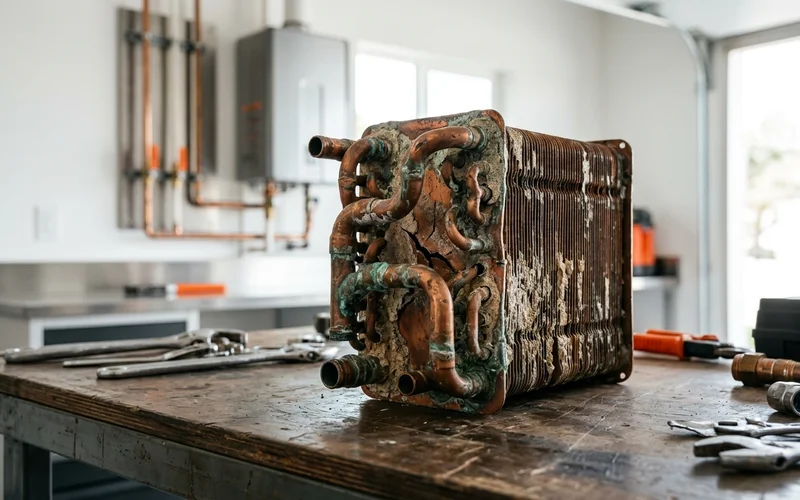
The heat exchanger acts as the engine of your water heater, and its condition is often the final tipping point. A new replacement part usually runs between $1,200 and $2,200 in California.
We consider choosing to replace tankless heat exchanger components on an older unit to be a poor financial investment. Routine repairs like swapped sensors, igniters, flame rods, and flow valves are highly affordable and straightforward.
You will typically notice a failing heat exchanger through a few clear warning signs:
- Water pooling inside the bottom of the metal cabinet.
- Repeated error codes related to ignition or exhaust blockages.
- A sudden, massive drop in total hot water pressure.
A cracked or severely scaled heat exchanger on an out-of-warranty system simply does not make sense to fix. Southern California tap water averages around 254 parts per million in hardness, which destroys unprotected metal rapidly.
Scale buildup restricts the internal water flow and causes the metal to overheat and inevitably crack.
Factor 4: Repair Cost vs New Install Cost
A complete tank-to-tankless conversion usually runs $4,500 to $7,500 depending on the complexity of the job. Replacing an existing tankless unit costs significantly less if your current gas line and ventilation pipes meet modern code.
We strongly suggest comparing your specific repair quote against the cost of a brand-new unit for your exact setup. A generic replacement estimate online will not account for the reusable infrastructure already in your home.
Upgrading to a high-efficiency system can also qualify for utility incentives, such as SoCalGas rebates on qualifying models. The federal Section 25C credit ended for equipment installed after 2025, so check current rules before counting on it.
| Cost Factor | Estimated California Range |
|---|---|
| Minor Repair (Sensors, Valves) | $150 to $400 |
| Major Repair (Heat Exchanger) | $1,200 to $2,200 |
| New Tankless Swap (Using existing lines) | $2,500 to $4,000 |
| Full Conversion (New lines and venting) | $4,500 to $7,500 |
Any rebate you qualify for, plus lower monthly gas bills, can make a new installation easier to justify.
The 50 Percent Rule: You should seriously look at a full replacement if a single repair approaches fifty percent of the total cost of a new unit.
Factor 5: Efficiency Gains and Fit
Newer models operate with incredible efficiency, offering a perfect opportunity to correct problems with your original setup. Modern condensing units now achieve a Uniform Energy Factor (UEF) of 0.95 or higher.
We look at a replacement job as a chance to evaluate your home’s total hot water demand. Upgrading your equipment can resolve several frustrating daily issues:
- Undersized unit capacity. You will never run short of hot water when two showers are running if you install a properly sized 199,000 BTU unit.
- Non-condensing to condensing. Upgrading to a condensing model captures exhaust heat to warm incoming water, lowering your operating costs significantly.
- Old install shortcuts. A replacement allows professionals to fix undersized half-inch gas lines or improper venting that trigger frequent error codes.
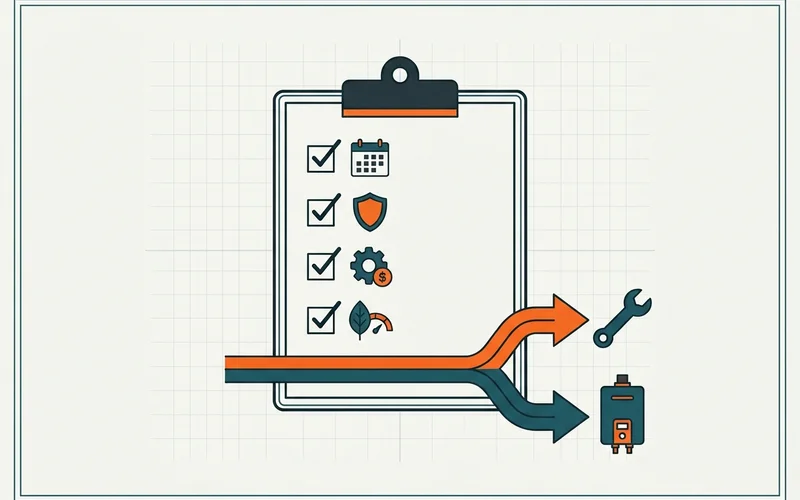
Tankless Water Heater Repair or Replace: Quick Reference
Deciding whether to replace a part or install a new system often comes down to clear categories. This fast reference chart outlines how professional plumbers evaluate common failures.
| Situation | Our usual recommendation |
|---|---|
| Failed flow sensor, thermistor, igniter or flame rod | Repair (Parts usually under $300) |
| Leaking fitting, valve or relief valve | Repair |
| Dirty flame rod or scale-related codes (e.g., Error 11) | Service, flush, and repair |
| Heat exchanger failure, unit under warranty | Repair under warranty |
| Heat exchanger failure, older unit out of warranty | Usually replace |
| Repeated major repairs in a short period | Consider replacement |
| Unit never kept up with your demand | Replace with a correctly sized unit |
We tell you if it is not worth fixing
Honest communication is a core part of how our company operates. If a repair makes financial sense, the technician will recommend it. If spending money on an old unit is throwing good money after bad, the team will clearly state that in writing.
Three Real-World Scenarios
These common examples show how age, warranty status, and water hardness force a clear choice. They represent typical situations we see daily across Los Angeles and surrounding counties.
Scenario A: Healthy unit, failed sensor
A four-year-old unit suddenly starts cutting out mid-shower. Diagnostics reveal a failed flow sensor and moderate mineral scale buildup inside the pipes.
Recommendation: Repair.
We will replace the flow sensor for a few hundred dollars and perform a thorough chemical flush. This unit still has well over a decade of reliable life left.
Scenario B: Older unit, heat exchanger leak, out of warranty
A twelve-year-old system with no service history has water pooling inside the metal cabinet. The diagnosis finds a cracked, heavily scaled heat exchanger, and the original manufacturer warranty expired two years ago.
Recommendation: Usually replace.
We strongly advise against spending $1,800 to replace a heat exchanger on a unit this old. A new system comes with a fresh manufacturer warranty and better energy efficiency.
Scenario C: Unit that never kept up
A household constantly runs out of hot water when running the dishwasher and shower simultaneously, and the system now displays an ignition error code. An inspection finds a dirty flame rod, an undersized half-inch gas line, and a unit that is simply too small for the home.
Recommendation: Compare both options.
We can quote a repair with a gas line correction alongside a proposal for a brand-new 199,000 BTU unit. A full replacement solves both the capacity problem and the frustrating error codes immediately if the current unit is aging.
| Scenario | Unit age | Main issue | Typical call |
|---|---|---|---|
| A | Newer (4 years) | Sensor failure | Repair |
| B | Older (12 years) | Heat exchanger leak, no warranty | Replace |
| C | Varies | Undersized unit plus gas issue | Compare both |
What Replacement Involves
Choosing to upgrade means the project will follow our standard tankless water heater installation process from start to finish. Tankless-to-tankless swaps are usually much simpler and faster than converting from a traditional tank.
We confirm the correct sizing requirements and verify that your existing gas lines meet the rigorous 2026 California Title 24 energy standards. Southern California also enforces strict low-NOx emissions rules through local air quality management districts.
A compliant, professional replacement includes several mandatory steps:
- Upgrading gas lines to handle the required BTU load safely.
- Rerouting or replacing PVC ventilation to match the new unit’s specifications.
- Pulling the required city permits and securing local safety sign-offs.
Our installation team handles all of this documentation and registers your fresh factory warranty. You can review our detailed installation cost guide to understand exactly what drives local pricing.
Making the Call
Making a final tankless water heater repair or replace choice is straightforward when you rely on hard data.
- Get a professional diagnosis instead of guessing based on an internet search.
- Check your active warranty status for parts and labor coverage.
- Compare the specific repair quote against a customized replacement estimate for your home.
- Factor in the unit’s age, its federal efficiency rating, and whether it ever truly met your household demand.
We are ready to evaluate your system and provide clear, honest guidance. Send the team your current error code alongside a photo of the unit’s rating label.
Our experts will help you figure out the most cost-effective path forward. For a deeper breakdown of what common fixes currently run, see the breakdown on tankless repair cost in California.